Why Pet-Friendly Hotels Can Still Surprise Travelers at Check-In
A hotel may welcome pets but still limit size, fees, rooms, public areas, and whether animals can be left alone. The safest move is to check the property’s exact rules before you book.
A pet-friendly hotel is not always as simple as it sounds.
The label may mean your dog is welcome. It may also mean your pet must meet a weight limit, stay out of dining areas, avoid being left alone in the room, or come with a fee that was not obvious on the first booking screen.
That gap between the friendly headline and the hotel’s actual rules is where many travelers get caught.
For anyone traveling with a dog or cat, especially across countries or through third-party booking sites, “pet-friendly” should be treated as a starting point. It is not the full policy.
The label does not mean one universal rule
One of the easiest mistakes is assuming that a hotel brand has one pet rule everywhere.
In reality, policies can change from one property to another. Hyatt’s own pet-friendly hotel page tells travelers that each hotel may have specific pet policies and that guests should contact the hotel for details.
That one sentence explains a lot.
A resort with outdoor space may handle pets differently from a downtown hotel with narrow halls and crowded elevators. A small boutique property may allow only one pet because it has limited rooms. A large hotel may allow dogs but still restrict them from restaurants, pools, lounges, or shuttle services.
For global travelers, including Americans visiting Thailand, Japan, Europe, or Southeast Asia, the key point is simple: the booking filter can help you find possibilities, but the hotel’s own policy decides what is actually allowed.
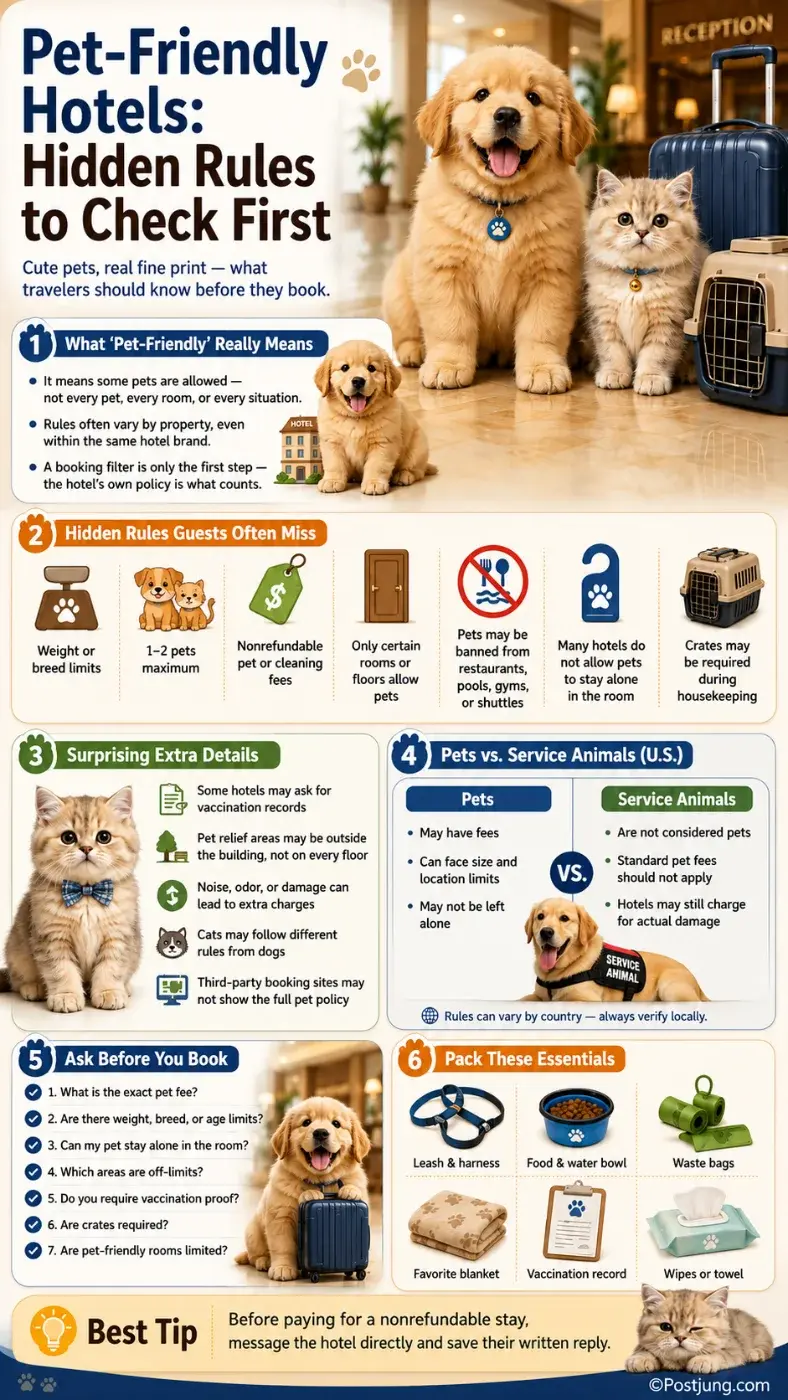
The rules guests often miss
Most surprises fall into a few predictable categories.
The first is cost. A hotel may charge a nonrefundable pet fee, a cleaning fee, or a fee that changes depending on length of stay. One Hyatt Place pet policy, for example, lists a nonrefundable fee for shorter stays and an additional cleaning fee for longer stays. It also tells guests to check with the hotel for stays beyond a certain length.
The second is size. Some hotels allow small dogs but not larger ones. The same Hyatt Place policy limits pets by weight and number of household pets per room, while a Hyatt House property in Pennsylvania lists its own dog limits and fees at the property level.
The third is where the pet can go.
A dog may be allowed in the guest room but not in food service areas, pool areas, or other shared spaces. Some policies also require dogs to be leashed in public areas. Those details can matter if a traveler plans to eat breakfast at the hotel, use the pool, or move through busy lobby spaces with a nervous pet.
The fourth is whether the pet can be left alone.
This is one of the most overlooked rules. Some hotels do not allow pets to remain unattended in the room. Others require a carrier during housekeeping or ask guests to arrange service while they are present. That can change a traveler’s entire day, especially if the plan includes a museum, spa, temple, restaurant, conference, or beach that does not allow animals.
Service animals are not the same as pets
For American readers, there is another important distinction: pets and service animals are not treated the same under U.S. ADA guidance.
The U.S. Department of Justice says hotels may not restrict guests with service animals to only “pet-friendly” rooms. It also says hotels cannot charge cleaning fees for hair or dander from a service animal, though they may charge for damage in the same way they would charge other guests.
The ADA also draws a line between service animals and emotional support, therapy, comfort, or companion animals. Under ADA guidance, those animals do not qualify as service animals unless they are trained to perform a specific task related to a disability.
That does not mean every country, airline, hotel, or local rule works the same way. It means travelers should avoid assuming that a pet policy, a service animal policy, and an emotional support animal policy are interchangeable.
They are not.
Why hotels write so much fine print
From the guest side, the rules can feel frustrating. From the hotel side, pets affect nearly every part of the stay.
Housekeeping may need more time. Other guests may have allergies. A dog left alone may bark. A nervous pet may struggle in elevators or hallways. Damage, odor, and extra cleaning can create costs after checkout.
Hotels also have to balance pet owners with guests who did not choose to be near animals. A family with small children, a guest with allergies, or someone working from a hotel room may experience the same property very differently.
That is why many pet policies focus less on cuteness and more on control: weight limits, leashes, carriers, restricted areas, cleaning fees, noise rules, and damage responsibility.
A good pet-friendly hotel is not one with no rules. It is one with clear rules that travelers can understand before they arrive.
What to check before booking
Before paying for a nonrefundable room, travelers should confirm the details directly with the hotel.
Ask whether your pet’s species, size, and weight are allowed. Ask how many pets can stay in one room. Ask whether the fee is per night, per stay, or per pet. Ask if pets can be left alone in the room. Ask which public areas are off-limits.
If traveling with a cat, ask specifically about cats. Some hotels use “pet-friendly” language but mainly design their policy around dogs.
It is also smart to save the hotel’s written reply, especially when booking through a third-party platform. A short message from the property can prevent a stressful check-in conversation later.
For trips in Thailand or elsewhere in Southeast Asia, this habit is especially useful because property styles vary widely. A luxury resort, city hotel, serviced apartment, and small boutique stay may all use similar “pet-friendly” wording while applying very different house rules.
The real meaning of pet-friendly
“Pet-friendly” should not be read as a promise that every pet, in every situation, will be accepted without conditions.
It means the property has some pathway for guests traveling with animals. The important question is whether that pathway fits your pet, your budget, and your plans.
The best pet-friendly stay usually happens before arrival, not at check-in. The guest asks the right questions. The hotel confirms the rules. The pet arrives expected, not as a surprise.
That is the practical truth behind the label: the welcome may be real, but so are the limits.
KEY TAKEAWAYS:
- “Pet-friendly” does not mean every pet is allowed without conditions.
- Pet fees, weight limits, room rules, and public-area restrictions often vary by property.
- U.S. service animal rules are different from ordinary hotel pet policies.
- Travelers should confirm the exact policy directly with the hotel before booking.
- Saving the hotel’s written answer can help avoid problems at check-in.
U.S. Department of Justice ADA, Hyatt, Original source material
References:
https://www.ada.gov/resources/service-animals-faqs/
https://www.hyatt.com/promo/pet-friendly-hotels-at-hyatt
https://www.hyatt.com/content/dam/hotel/propertysites/assets/place/slczm/documents/en-us/home/Hyatt_Place_Pet_Policy.pdf

เขียนโดย Postjung Insights
 5 คณะที่เรียนจบมาแล้ว มีอาชีพรองรับมากกว่าที่คิด
 รู้หรือไม่? เปิดรายได้พนักงานส่งพัสดุของแต่ละแอป วันหนึ่งได้เท่าไร
 โรงเรียนที่มีนักเรียนมากที่สุดในไทย
 Google ยอมรับแล้ว! Gemini AI เข้าถึงระบบบริษัทจริง 3 แห่ง ระหว่างการทดสอบความปลอดภัย
 ตาราง “เด่นเหนือเด่นใต้” งวด 1 ต.ค. 69 เปิดข้อมูลตามโพย เลขไหนอยู่ตรงไหน
 อำเภอที่มีชื่ออำเภอสั้นที่สุด 3 อำเภอเท่านั้นในประเทศไทย
 เปิดรายชื่อโรงเรียนในไทยที่ “ว่ายน้ำ” อยู่ในหลักสูตร เรียนจริงตั้งแต่อนุบาลถึงมัธยม
 จุฬาฯ มหาวิทยาลัยแห่งแรกของไทย มีจุดเริ่มต้นในสมัยรัชกาลที่ 5
 เลขเด็ดปฏิทิน "หลวงปู่โต๊ะ" งวดวันที่ 1 ตุลาคม 69..ส่องเลย เลขไหนให้โชค!
 อุทยานเขาใหญ่เรียกตัว “ตีนผี” หลังขับจี้ช้างป่าพ่อลูก ลั่นระยะ 50 เมตรต้องจำให้ขึ้นใจ
 เปิด 5 โรงเรียนหญิงล้วนเก่าแก่ของไทย ที่มีประวัติยาวนานกว่าศตวรรษ
 สถิติย้อนหลัง 10 ปี ออกเลขไหนบ้างมาดูกัน
 😃 ชวนเข้ามาดูกันอีกกับคนที่มีร่างกายพิเศษจนเหมือนมีกล่องสมบัติที่หายาก 😯5 คณะที่เรียนจบมาแล้ว มีอาชีพรองรับมากกว่าที่คิดเปิดรายชื่อโรงเรียนในไทยที่ “ว่ายน้ำ” อยู่ในหลักสูตร เรียนจริงตั้งแต่อนุบาลถึงมัธยมGoogle ยอมรับแล้ว! Gemini AI เข้าถึงระบบบริษัทจริง 3 แห่ง ระหว่างการทดสอบความปลอดภัยเลขเด็ดปฏิทิน "หลวงปู่โต๊ะ" งวดวันที่ 1 ตุลาคม 69..ส่องเลย เลขไหนให้โชค!
 ทำไมของพลาสติกเก่าบางชิ้นถึง “เหนียว” ขึ้นมาเอง ทั้งที่ไม่ได้เปื้อนอะไร?
 English Edition