Why Your Pet’s “Bad Behavior” May Really Be Boredom

Chewing, barking, scratching, and midnight chaos are often signs that pets need more mental stimulation, not just stricter rules.
A dog that chews the couch is not plotting revenge. A cat that knocks things off the table is not trying to ruin your morning.
Most of the time, behavior that owners call “bad” is really a signal. The pet has energy, instincts, curiosity, or stress that has nowhere useful to go.
That does not mean torn pillows, scratched furniture, or nonstop barking should be ignored. It means the first question should not always be, “How do I stop this?” A better question is often: what need is this behavior meeting?
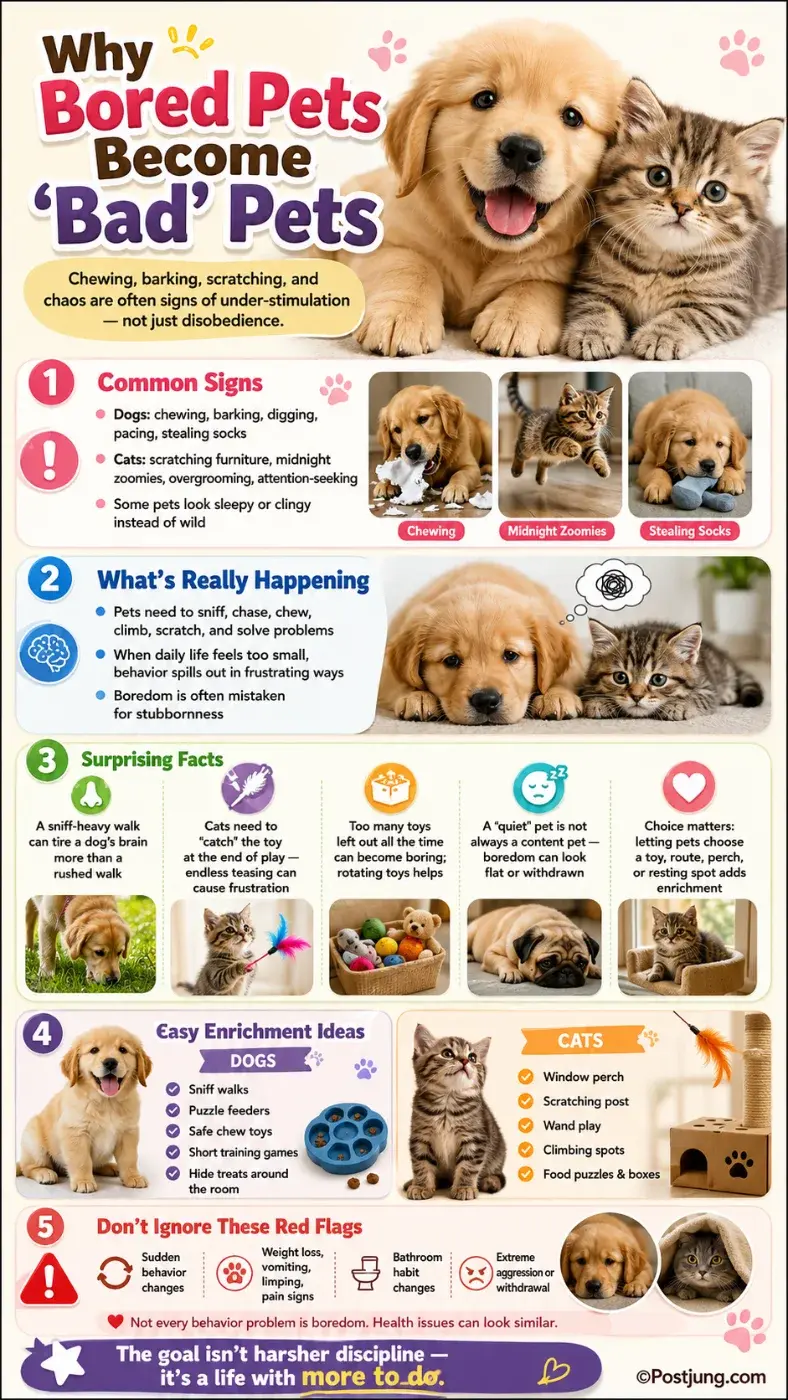
Dogs and cats are not decorative roommates. Dogs are built to sniff, chew, chase, dig, solve problems, and explore. Cats are built to stalk, pounce, climb, scratch, hide, and watch the world from safe places. When daily life gives them too few chances to do those things, the behavior can come out sideways.
A bored pet may look naughty. In reality, the pet may be under-stimulated.
“Bad” behavior often has a purpose
Many unwanted pet behaviors are self-made entertainment.
A bored dog may chew because chewing feels good and burns nervous energy. It may bark because every sound outside becomes the most interesting thing happening all day. It may dig, pace, steal socks, jump on visitors, or follow its owner from room to room because anything feels better than doing nothing.
Cats can show boredom in quieter but equally frustrating ways. Some scratch furniture more often. Some wake people at night, bite during play, chase invisible prey, overgroom, or become unusually demanding. Others appear to sleep all day, then explode into activity after midnight.
None of this proves boredom by itself. Pain, illness, anxiety, fear, poor training, and environmental stress can all change behavior. But boredom is easy to miss because many pets live physically safe lives that are mentally very small.
Food appears in a bowl. Toys sit untouched in the same corner. Walks follow the same route. The window view never changes. The humans are busy.
For an intelligent animal, that can become frustrating fast.
Enrichment is not a luxury
Pet enrichment can sound like an extra, but it is closer to daily quality of life.
Enrichment means giving animals safe ways to use their bodies, senses, and brains. The ASPCA describes in-home enrichment as a way to keep dogs stimulated and help reduce boredom-related behavior issues.
For dogs, enrichment may include sniff walks, puzzle feeders, training games, chew toys, hide-and-seek, or time to explore new smells. For cats, it may mean climbing spaces, scratching posts, window perches, wand toys, food puzzles, cardboard boxes, or short hunting-style play sessions.
The goal is not to exhaust a pet until it collapses. The goal is to let the animal behave like the animal it is.
That difference matters. A long walk may help a dog, but a slower walk with time to sniff can be more mentally satisfying than a fast march around the block. A cat may ignore an expensive toy but become fascinated by a cardboard box, a paper bag, or a moving string.
Good enrichment is not about buying the fanciest gear. It is about matching the activity to the animal’s instincts.
Dogs need more than exercise
Many dog owners assume exercise solves everything. Exercise helps, but movement alone is not always enough.
A dog that spends its whole walk being pulled away from every smell may return home physically tired but mentally unsatisfied. For dogs, sniffing is information. A patch of grass can be a news feed, a social network, and a mystery novel all at once.
That is why sniff time can be powerful. Letting a dog pause, investigate, and make safe choices gives the dog mental work to do.
Training can help too, not because every dog needs impressive tricks, but because learning creates structure. Simple cues such as sit, wait, find it, or touch can give a dog a job.
Chewing is another normal outlet. The ASPCA advises giving dogs appropriate chew items and rotating toys so they do not become bored with the same options.
A dog with nothing to do may invent a hobby. Unfortunately, that hobby may be barking at delivery drivers or destroying pillows.
Cats need a world, not just a room
Cats are often misunderstood because they seem independent.
Many indoor cats are physically protected but environmentally underfed. They may have food, water, and a litter box, yet still lack enough chances to climb, hide, scratch, watch movement, stalk, and pounce.
Cornell Feline Health Center notes that toys can encourage exercise and cognitive enrichment while allowing cats to engage in natural behaviors such as stalking, pouncing, and problem-solving. Cornell also connects a lack of stimulation with problems such as destructive scratching and inappropriate elimination.
A cat tree near a window can be more than furniture. It gives height, territory, and a changing view. A scratching post is not a favor to the cat; scratching is a normal outlet for stretching, marking, and claw maintenance.
Wand play is not just exercise. It lets a cat complete part of the hunting sequence: watch, stalk, chase, catch.
That final “catch” matters. If a toy only teases a cat forever without letting it win, play can become frustrating instead of satisfying.
For cats, boredom often hides behind the myth of low maintenance.
Punishment can miss the point
When a pet acts out, punishment may stop the behavior in the moment. It rarely fixes the reason behind it.
Yelling at a dog for chewing does not teach it what to chew instead. Spraying a cat for scratching does not remove the need to scratch. In some cases, punishment can increase fear, stress, or attention-seeking behavior.
A better approach is to redirect the instinct.
If a dog chews shoes, make appropriate chew items more interesting and keep shoes out of reach. If a cat scratches the sofa, place a better scratching surface nearby and reward the cat for using it. Cornell recommends placing scratching posts near areas a cat already likes to scratch, then rewarding use of the post.
This is not about letting pets “get away with it.” It is about solving the real problem instead of fighting the symptom.
What owners often miss
Boredom does not always look like chaos.
Some pets become restless and destructive. Others become flat, clingy, sleepy, or irritable. A pet that has “calmed down” may not always be content; it may have stopped trying.
That is why sudden changes deserve attention. If a dog that normally plays becomes withdrawn, or a cat that normally uses the litter box starts eliminating outside it, boredom should not be the only explanation.
Health problems, pain, anxiety, urinary issues, dental disease, arthritis, and other conditions can change behavior. Owners should be especially careful when behavior appears suddenly, becomes intense, or comes with appetite changes, bathroom changes, limping, vomiting, weight loss, aggression, or signs of pain.
Boredom is common, but not every behavior problem is a boredom problem.
A better rhythm can change the day
For many households, the fix is not a complete lifestyle change. It is a better rhythm.
A dog may need one walk where sniffing is the point, not speed. A cat may need two short play sessions and a window perch. A pet that eats from a bowl every day may benefit from puzzle feeding a few times a week. Toys can be rotated instead of left out until they become invisible.
The Ohio State University’s Indoor Pet Initiative points cat owners toward enriched indoor environments and problem-solving resources for issues including anxiety and boredom.
Small changes can make a home feel bigger to an animal.
Try giving pets choices: which toy, which resting spot, which safe chew, which route, which game. Choice matters because it gives animals some control over their day.
The best pet homes are not the ones with the most expensive supplies. They are the ones where humans notice what the animal is trying to do and create a safe version of it.
A “bad” pet may be a bored pet.
And a bored pet is often not asking for punishment. It is asking for a life with more to do.
KEY TAKEAWAYS:
- Chewing, barking, scratching, and nighttime chaos can be signs of boredom or unmet instincts.
- Dogs often need sniffing, chewing, training, and problem-solving—not just fast exercise.
- Cats need climbing, scratching, hiding, stalking, and play that lets them “catch” something.
- Punishment may stop a behavior briefly but often misses the reason behind it.
- Sudden or intense behavior changes should be checked carefully because health issues can look like behavior problems.
ASPCA, Cornell Feline Health Center, Ohio State University Indoor Pet Initiative
References:
https://www.aspca.org/pet-care/dog-care/canine-diy-enrichment
https://www.aspca.org/pet-care/dog-care/common-dog-behavior-issues/destructive-chewing
https://www.vet.cornell.edu/departments-centers-and-institutes/cornell-feline-health-center/health-information/feline-health-topics/safe-toys-and-gifts

เขียนโดย Postjung Insights
 อำเภอที่มีชื่ออำเภอสั้นที่สุด 3 อำเภอเท่านั้นในประเทศไทย
 คุณนุชออกโรงชี้แจง ปมมีภาพถ่ายร่วมสัมภาษณ์ “หนุ่ม กรรชัย” ยอมรับผิด พร้อมขอโทษทุกฝ่าย
 5 คณะที่เรียนจบมาแล้ว มีอาชีพรองรับมากกว่าที่คิด
 รู้หรือไม่? เปิดรายได้พนักงานส่งพัสดุของแต่ละแอป วันหนึ่งได้เท่าไร
 โรงเรียนเพียงแห่งเดียวของประเทศไทย ที่อยู่มาตั้งแต่ยุครัชกาลที่ 4
 แทสเมเนีย: ถอดรหัสเกาะปริศนาที่แผนที่โลกมักลืมเขียน
 ตาราง “เด่นเหนือเด่นใต้” งวด 1 ต.ค. 69 เปิดข้อมูลตามโพย เลขไหนอยู่ตรงไหน
 Phnom Penh Post ยกประวัติศาสตร์ขอมตอบโต้ข่าวภาพหญิง ร.5 แต่ปมสำคัญยังอยู่ที่หลักฐานของภาพ
 AI กำลังเปลี่ยนตลาดงาน เปิด 5 สาขามหาวิทยาลัยที่ไทยต้องการบุคลากรในอีก 5 ปี
 แปลปกสลาก งวด 1 ต.ค. 69 ส่องตัวเลขจากภาพปกสลากกินแบ่งรัฐบาล
 เลขขายดีงวดนี้ 1 ตุลาคม 2569 สำรวจกระแสเลขเด่นก่อนหวยออก พร้อมวิธีอ่านข้อมูลอย่างมีสติ
 โรงเรียนที่มีนักเรียนมากที่สุดในไทยAI กำลังเปลี่ยนตลาดงาน เปิด 5 สาขามหาวิทยาลัยที่ไทยต้องการบุคลากรในอีก 5 ปีPhnom Penh Post ยกประวัติศาสตร์ขอมตอบโต้ข่าวภาพหญิง ร.5 แต่ปมสำคัญยังอยู่ที่หลักฐานของภาพแทสเมเนีย: ถอดรหัสเกาะปริศนาที่แผนที่โลกมักลืมเขียนเลขขายดีงวดนี้ 1 ตุลาคม 2569 สำรวจกระแสเลขเด่นก่อนหวยออก พร้อมวิธีอ่านข้อมูลอย่างมีสติ
 ทำไมคนไทยยังแห่ซื้อ"iPhone 18" ทั้งที่ราคาสูง แต่ค่าครองชีพสวนทางกับรายได้?
 จากยาพิษโบราณสู่อาณาจักรหมื่นล้าน: มหากาพย์ “อัลมอนด์” พืชเศรษฐกิจที่สร้างแคลิฟอร์เนีย
 English Edition