Why Senior Cats May Meow More at Night
Extra nighttime crying can come from aging, confusion, pain, or medical changes that owners should not ignore.
A senior cat crying in the hallway at 2 a.m. can feel oddly heartbreaking.
One minute the house is quiet. The next, an older cat is meowing into the dark as if looking for someone, asking for something, or trying to make sense of a room it has known for years.
For many cat owners, the first reaction is confusion. Is the cat lonely? Hungry? Being dramatic? Or is something wrong?
The answer is often not one simple thing. Older cats may vocalize more at night because their bodies, senses, routines, and brains change with age. Sometimes the behavior is manageable with small adjustments at home. Other times, a new nighttime voice is a health clue.
That is why the sound matters.
Night makes small problems feel bigger
Cats are naturally active during low-light hours, but senior cats can become especially unsettled when the house gets dark and quiet.
During the day, normal household movement may help orient them. They hear voices, see people walking around, smell food, and follow familiar routines. At night, those cues disappear. A cat with fading vision, hearing changes, stiff joints, or mild confusion may suddenly feel less secure.
That can lead to meowing, pacing, or calling out from another room.
The Cornell Feline Health Center notes that night-time vocalizing can be seen in older cats with conditions such as hyperthyroidism or hypertension, and that hypertension can also contribute to vision problems that may increase anxiety and confusion.
In other words, nighttime meowing is not always “bad behavior.” It may be a cat’s way of saying the world feels different.
Cognitive changes can show up after dark
One common concern in senior cats is cognitive dysfunction, a condition often compared to dementia-like changes in older pets.
Cats with cognitive decline may seem disoriented, stare at walls, forget familiar routines, sleep at unusual times, wander, or vocalize more. Nighttime can make these changes more obvious because the environment is quieter and the cat may be awake while the household is asleep.
Research on feline cognitive dysfunction has described increased wandering, vocalization, and night-time activity in older cats when other medical causes are not identified.
This does not mean every older cat who meows at night has cognitive dysfunction. But if the meowing is paired with confusion, changes in litter box habits, altered sleep, or seeming “lost” in familiar spaces, it is worth bringing up with a veterinarian.
Pain is easy to miss in cats
Cats are famous for hiding discomfort. A senior cat with arthritis may still jump on the sofa, but hesitate before climbing stairs. A cat with dental pain may still eat, but chew differently. A cat with abdominal discomfort may look quiet during the day, then become restless at night.
VCA Animal Hospitals notes that cats in pain may vocalize, and that conditions such as thyroid disease, kidney problems, and high blood pressure can also be linked with howling or unusual vocal behavior.
This is one of the biggest misunderstandings about older cats: loud meowing is not always emotional.
It can be physical.
A cat may cry because getting up hurts. It may call because it cannot settle. It may become louder because a medical problem is making the body feel uncomfortable or overstimulated.
Thyroid disease, kidney issues, and blood pressure matter
In senior cats, several medical conditions can change behavior before owners realize there is a health issue.
Hyperthyroidism, which is common in older cats, can make a cat restless, hungry, thinner, more active, and louder. Kidney disease may increase thirst, urination, nausea, or general discomfort. High blood pressure can affect the eyes and brain, sometimes making a cat seem anxious or confused.
These conditions can overlap. A cat may not simply be “old.” It may be old and dealing with a treatable problem.
The ASPCA advises that if an elderly cat has just started meowing excessively, the cat should be evaluated by a veterinarian for possible medical conditions, sensory deficits, and cognitive dysfunction.
That advice is especially important when the change is sudden.
What owners should watch for
The meowing itself is only one part of the story. The more useful question is what else changed.
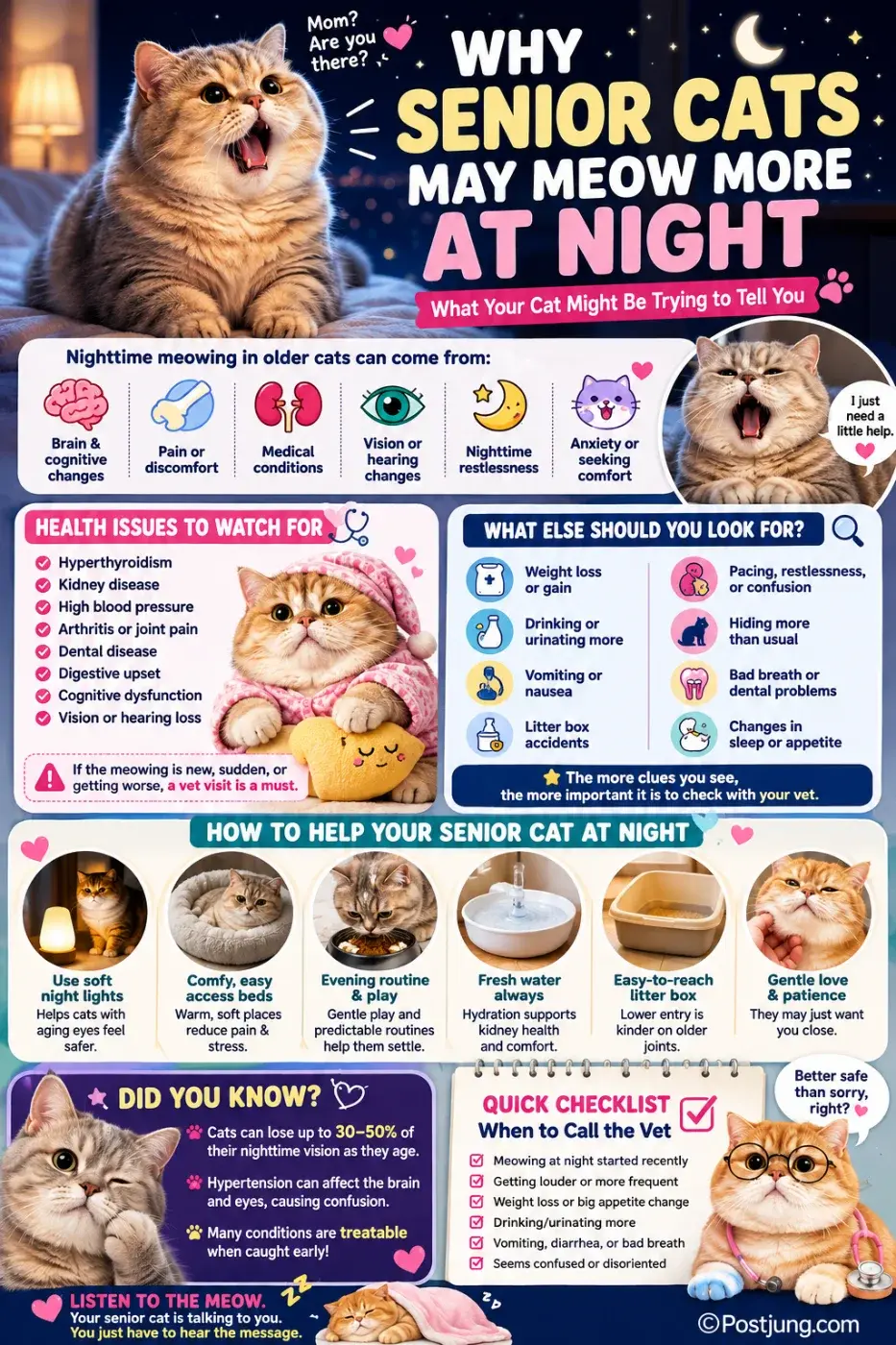
Owners should pay attention if nighttime crying comes with weight loss, increased appetite, increased thirst, more urination, vomiting, hiding, pacing, staring, bumping into objects, litter box accidents, stiffness, bad breath, or a change in grooming.
A cat who meows at night but otherwise seems stable may need routine changes and comfort. A cat who suddenly becomes louder and also loses weight or drinks much more water needs a medical check.
A simple log can help. Note when the meowing happens, how long it lasts, where the cat is standing, whether food or attention stops it, and whether any other symptoms appear.
This gives the veterinarian more than “my cat is noisy.” It gives a pattern.
Comfort can help, but do not skip the health check
Once medical problems have been considered, small home changes may reduce nighttime stress.
A night light can help a cat with weaker vision navigate the home. Soft bedding in an easy-to-reach location may help a cat with stiff joints. Food, water, and litter boxes should be accessible without stairs or difficult jumps. A predictable evening routine can also help some cats settle.
For cats who seem lonely or disoriented, gentle reassurance before bedtime may be useful. But repeatedly getting up to feed or reward loud meowing can accidentally train the behavior if hunger is not the real issue.
The goal is not to ignore the cat. The goal is to understand what the cat is asking for.
What American and global cat owners may misunderstand
In many homes, a senior cat is treated as “just slowing down.” That can make owners miss early signs of discomfort.
Older cats do change. They sleep more. They may become more attached to routines. They may want warmth, softer resting places, and easier access to resources.
But aging is not a diagnosis.
A cat who suddenly cries at night deserves attention because many causes are manageable. Pain can sometimes be treated. Thyroid disease can be diagnosed. Blood pressure can be checked. Environmental stress can be reduced. Cognitive changes can be supported.
The sound may be annoying at 2 a.m., but it may also be one of the clearest signals a cat can give.
When to call the vet
A vet visit is wise if the meowing is new, suddenly worse, unusually loud, or paired with physical or behavioral changes.
It is also worth scheduling a check if the cat seems confused, loses weight, eats more than usual, drinks more water, urinates more, stops grooming, hides, limps, or has trouble jumping.
This article is not a substitute for veterinary care. Senior cats can have multiple issues at the same time, and a veterinarian can decide whether bloodwork, blood pressure checks, dental evaluation, pain assessment, or vision checks are needed.
For owners, the most helpful mindset is simple: listen to the change, not just the noise.
A senior cat meowing at night may be asking for comfort. It may be reacting to darkness. It may be confused. It may be in pain. It may be showing the first visible sign of a medical condition.
Either way, the meow is information.
And for an older cat, being heard can make the night feel safer.
Cornell Feline Health Center / ASPCA / VCA Animal Hospitals / Peer-reviewed veterinary research via PubMed Central
References:
Cornell Feline Health Center: Cognitive Dysfunction
ASPCA: Meowing and Yowling / Older Cats with Behavior Problems
VCA Animal Hospitals: Caterwauling in Cats
PubMed Central: Cognitive Dysfunction in Cats

เขียนโดย Postjung Insights
 โรงเรียนที่มีนักเรียนมากที่สุดในไทย
 5 คณะที่เรียนจบมาแล้ว มีอาชีพรองรับมากกว่าที่คิด
 รู้หรือไม่? เปิดรายได้พนักงานส่งพัสดุของแต่ละแอป วันหนึ่งได้เท่าไร
 อำเภอที่มีชื่ออำเภอสั้นที่สุด 3 อำเภอเท่านั้นในประเทศไทย
 รมว.วัฒนธรรมเอาจริง! จ่อส่งหนังสือทักท้วง Miss Universe Cambodia ปมใช้ภาพหญิงกำแพงเพชร หากไม่แก้ เตรียมใช้กฎหมาย
 งูมัลกา (Mulga Snake): นักล่าแห่งผืนดินแห้งแล้ง ของทวีปออสเตรเลีย กับฉายา King Brown กัดคนได้ถึงตาย
 ดูหนัง–ซีรีส์ฟรีอาจไม่ฟรีอย่างที่คิด! เปิดโทษละเมิดลิขสิทธิ์ เตือนคนปล่อยคอนเทนต์เถื่อน เสี่ยงทั้งคุกทั้งปรับ
 ตาราง “เด่นเหนือเด่นใต้” งวด 1 ต.ค. 69 เปิดข้อมูลตามโพย เลขไหนอยู่ตรงไหน
 เปิด 5 โรงเรียนหญิงล้วนเก่าแก่ของไทย ที่มีประวัติยาวนานกว่าศตวรรษ
 แมงป่อง: แมลงนักล่าสายพันธุ์โบราณของโลก ที่ยังคงอยู่มาจนถึงปัจจุบัน
 แมคาเดเมีย (Macadamia): ราชินีแห่งถั่ว กับขุมทรัพย์โภชนาการจากออสเตรเลีย
 เปิดหลักฐานเก่า 120 ปี ปมภาพหญิงเมืองกำแพงเพชร โผล่เวที Miss Universe Cambodia 2026
 English Edition