Why Cheap Cat Trees Can Tip Over More Easily Than Owners Expect
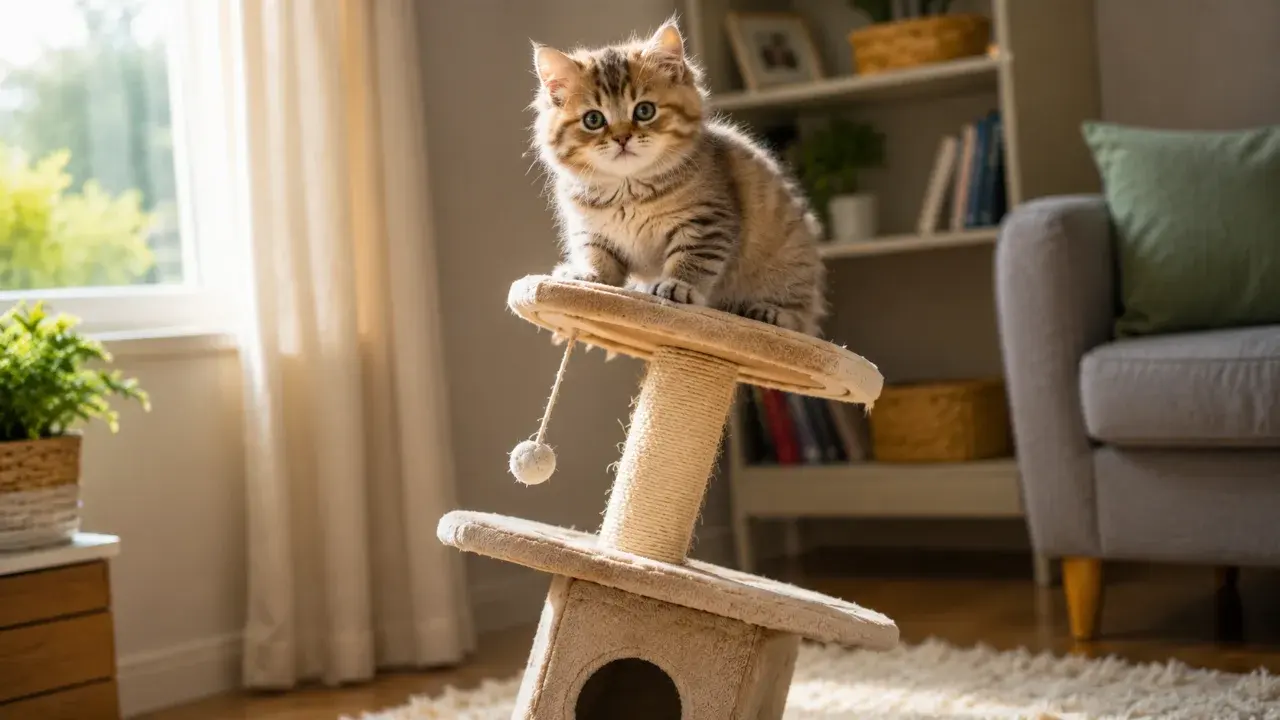
Cat trees give indoor cats the vertical space they love, but a tall tower with a narrow base, light materials, or loose joints can become unstable fast.
A cat tree can look sturdy in an online photo and still wobble the first time a cat jumps onto it.
That is the hidden problem with many cheap cat trees. They may look tall, soft, and fun, but once a real cat climbs, scratches, twists, or launches from one level to another, the structure has to handle much more movement than a product photo suggests.
For indoor cats, vertical space is not just decoration. The ASPCA notes that cats enjoy climbing and perching up high, and cat trees are one common way to create that space at home. A good cat tree can give a cat exercise, confidence, scratching options, and a place to observe the room.
But the word “tree” can be misleading. This is furniture. It has to carry weight, absorb impact, and stay steady while an animal with claws treats it like a perch, ladder, scratching post, and launchpad.
That is where cheaper models can run into trouble.
Height is not the only problem
Many owners assume a cat tree tips because it is too tall. Height matters, but it is not the full story.
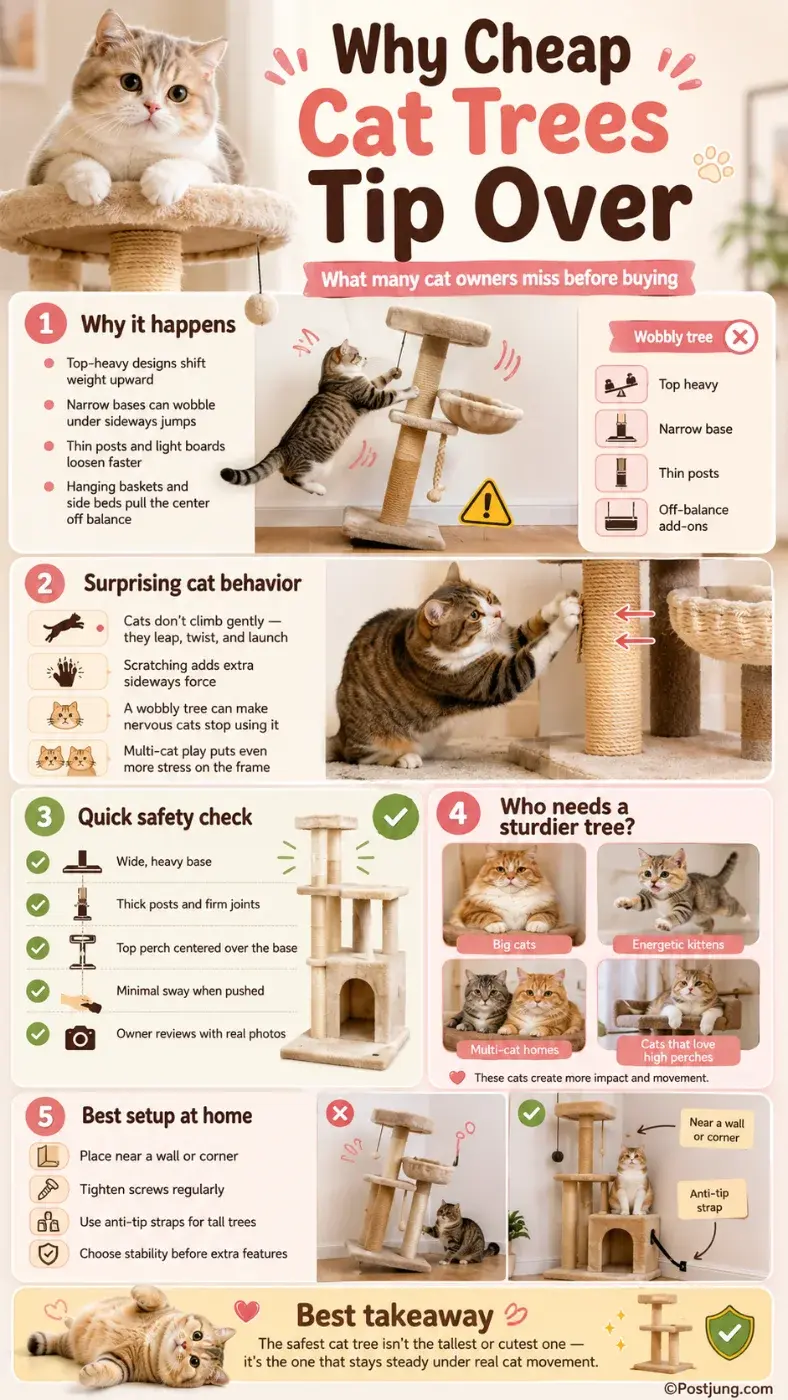
A tall cat tree can be stable if it has a wide, heavy base and strong joints. A shorter one can still wobble if the base is too narrow, the panels are light, or the posts loosen after repeated use.
The real issue is balance.
If most of the weight sits high up — platforms, beds, baskets, hammocks, toys, and a cat sitting on the top perch — the bottom of the tree has to be wide and heavy enough to counter it. Without that support, a sideways jump can shift the tree’s center of gravity quickly.
That is why some budget cat trees feel fine when they are empty but suddenly shaky when a cat climbs to the highest point.
Cats do not use cat trees gently
A cat tree is not like a bookshelf that mostly stands still.
Cats leap onto it. They push off from it. They dig their claws into the posts. They change direction in mid-play. In homes with more than one cat, one cat may chase another across the platforms, turning the whole structure into a moving obstacle course.
That sideways force is often what exposes a weak design.
A cat tree with a narrow base may stand upright during gentle use, but lean when a cat lands on an outer platform. Side-mounted beds, round condos, hanging baskets, or wide top perches can make the problem worse because they place weight away from the center.
The risk is not the same for every cat. A calm senior cat may use a low perch quietly. A large, athletic, young, or highly playful cat may need something much heavier and more reinforced.
Cheap materials may loosen faster
A cat tree does not always become unsafe in one dramatic moment. Sometimes it slowly becomes unstable.
Budget models may use lighter boards, thinner posts, weaker connectors, or soft coverings that hide how the structure is built. At first, the tree may seem tight. After weeks or months of scratching, jumping, and climbing, screws can loosen, platforms can tilt, and posts may begin to rotate.
Small movement matters.
Cats are sensitive to unstable surfaces. If a tree shifts under their paws, some cats may stop trusting it. A nervous cat may avoid the top perch. A heavier cat may keep testing it until the wobble gets worse.
A sturdy cat tree should feel like furniture, not a temporary prop.
Scratching makes stability even more important
Cat trees are often sold as climbing towers and scratching stations in one. That makes sense because scratching is normal cat behavior. Cornell Feline Health Center explains that scratching posts come in different shapes, sizes, and textures, and the right post should match a cat’s scratching preferences.
But scratching adds force.
When a cat stretches, grips, and pulls against a post, the tree has to resist that movement. A light tree may slide, wobble, or twist. If the post is too loose, the cat may prefer a sofa, rug, or heavier piece of furniture instead.
The ASPCA also advises offering cats scratching posts in different materials and orientations because cats may prefer vertical, horizontal, or slanted surfaces. That is useful for behavior, but it also points to a practical buying lesson: a scratching post is only helpful if it stays steady while the cat uses it.
Wall placement can help, but it is not a cure
Putting a cat tree against a wall or in a corner can make it feel more stable. It limits how far the structure can rock and gives cats a more secure climbing route.
For taller cat trees, an anti-tip strap or wall bracket may also help. The same basic idea applies to other tall furniture: if something is high, light, and used actively, it should not rely only on gravity.
Still, anchoring is not a magic fix.
If the tree is poorly built, already leaning, or too flimsy for the cat using it, a wall strap may reduce the chance of tipping but will not fix weak posts, sagging platforms, or loose hardware. Stability should come from the design first, then placement and anchoring.
What to check before buying
The first thing to check is the base. A wide, heavy base is usually more reassuring than a tall tower with many platforms but little support at the bottom.
Then look at the layout. If the highest perch extends far to one side, the tree may lean when a cat lands there. A design with too many side-mounted features may look fun online but behave differently in a real room.
Check the posts and joints. A simpler structure with thick posts and firm connections may be safer than a complicated tower with lightweight panels and decorative extras.
Read owner photos, not just product photos. Reviews that show the tree after weeks or months of use can reveal tilted posts, sagging beds, loose fabric, or a base that looks too small for the height.
Most important, match the tree to the cat. The right choice for a kitten may not be right for a large adult cat. A low, stable perch may be better than a tall tower that shakes every time the cat jumps.
The better question is not “Does it look cute?” It is “Will it stay steady when my cat uses it hard?”
The common misunderstanding
A cheap cat tree is not automatically dangerous. An expensive cat tree is not automatically safe.
The mistake is assuming all cat trees are basically the same because they share the same shape: posts, platforms, carpet, and a top perch.
They are not the same.
The hidden differences are in base weight, board density, hardware, post strength, layout, and how the design handles movement. These details are not always obvious in a listing photo, especially when the soft covering hides the structure underneath.
For American and global readers, the easiest comparison may be flat-pack furniture. A lightweight bookcase can look fine until it is loaded unevenly. A TV stand can seem stable until weight shifts. A cat tree faces the same physics, but with one big difference: the “weight” is alive, fast, and unpredictable.
That is why the cheapest tall tower is not always the best value. If it wobbles, the cat may avoid it. If it loosens quickly, it may need to be repaired or replaced. If it tips, it can scare the cat and damage nearby furniture.
A good cat tree does not need to be fancy. It needs to be steady, well-matched to the cat, and placed where the cat can use it with confidence.
For a cat, the best perch is not just the highest one. It is the one that does not move beneath their paws.
KEY TAKEAWAYS:
- Cheap cat trees often wobble because of narrow bases, light materials, weak joints, or top-heavy designs.
- Height alone is not the issue; balance and base weight matter just as much.
- Cats create sideways force when they jump, scratch, chase, and push off from platforms.
- Wall placement or anchoring can help, but it cannot fix poor construction.
- A good cat tree should match the cat’s size, energy level, and climbing habits.
ASPCA Pet Health Insurance, Cornell Feline Health Center, ASPCA
References:
https://www.aspcapetinsurance.com/resources/cat-enrichment/
https://www.vet.cornell.edu/departments-centers-and-institutes/cornell-feline-health-center/health-information/feline-health-topics/feline-behavior-problems-destructive-behavior
https://www.aspca.org/pet-care/cat-care/common-cat-behavior-issues/destructive-scratching

เขียนโดย Postjung Insights
 5 คณะที่เรียนจบมาแล้ว มีอาชีพรองรับมากกว่าที่คิด
 รู้หรือไม่? เปิดรายได้พนักงานส่งพัสดุของแต่ละแอป วันหนึ่งได้เท่าไร
 อำเภอที่มีชื่ออำเภอสั้นที่สุด 3 อำเภอเท่านั้นในประเทศไทย
 โรงเรียนที่มีนักเรียนมากที่สุดในไทย
 เลขเด็ดปฏิทิน "หลวงปู่โต๊ะ" งวดวันที่ 1 ตุลาคม 69..ส่องเลย เลขไหนให้โชค!
 ทำไมของพลาสติกเก่าบางชิ้นถึง “เหนียว” ขึ้นมาเอง ทั้งที่ไม่ได้เปื้อนอะไร?
 เปิดรายชื่อโรงเรียนในไทยที่ “ว่ายน้ำ” อยู่ในหลักสูตร เรียนจริงตั้งแต่อนุบาลถึงมัธยม
 Google ยอมรับแล้ว! Gemini AI เข้าถึงระบบบริษัทจริง 3 แห่ง ระหว่างการทดสอบความปลอดภัย
 จุฬาฯ มหาวิทยาลัยแห่งแรกของไทย มีจุดเริ่มต้นในสมัยรัชกาลที่ 5
 ตาราง “เด่นเหนือเด่นใต้” งวด 1 ต.ค. 69 เปิดข้อมูลตามโพย เลขไหนอยู่ตรงไหน
 แปลปกสลาก งวด 1 ต.ค. 69 ส่องตัวเลขจากภาพปกสลากกินแบ่งรัฐบาล
 เปิด 5 โรงเรียนหญิงล้วนเก่าแก่ของไทย ที่มีประวัติยาวนานกว่าศตวรรษ5 คณะที่เรียนจบมาแล้ว มีอาชีพรองรับมากกว่าที่คิดเปิดรายชื่อโรงเรียนในไทยที่ “ว่ายน้ำ” อยู่ในหลักสูตร เรียนจริงตั้งแต่อนุบาลถึงมัธยมGoogle ยอมรับแล้ว! Gemini AI เข้าถึงระบบบริษัทจริง 3 แห่ง ระหว่างการทดสอบความปลอดภัยเลขเด็ดปฏิทิน "หลวงปู่โต๊ะ" งวดวันที่ 1 ตุลาคม 69..ส่องเลย เลขไหนให้โชค!ทำไมของพลาสติกเก่าบางชิ้นถึง “เหนียว” ขึ้นมาเอง ทั้งที่ไม่ได้เปื้อนอะไร?
 อุทยานเขาใหญ่เรียกตัว “ตีนผี” หลังขับจี้ช้างป่าพ่อลูก ลั่นระยะ 50 เมตรต้องจำให้ขึ้นใจ
 English Edition