Why Dogs Tilt Their Heads When You Talk to Them
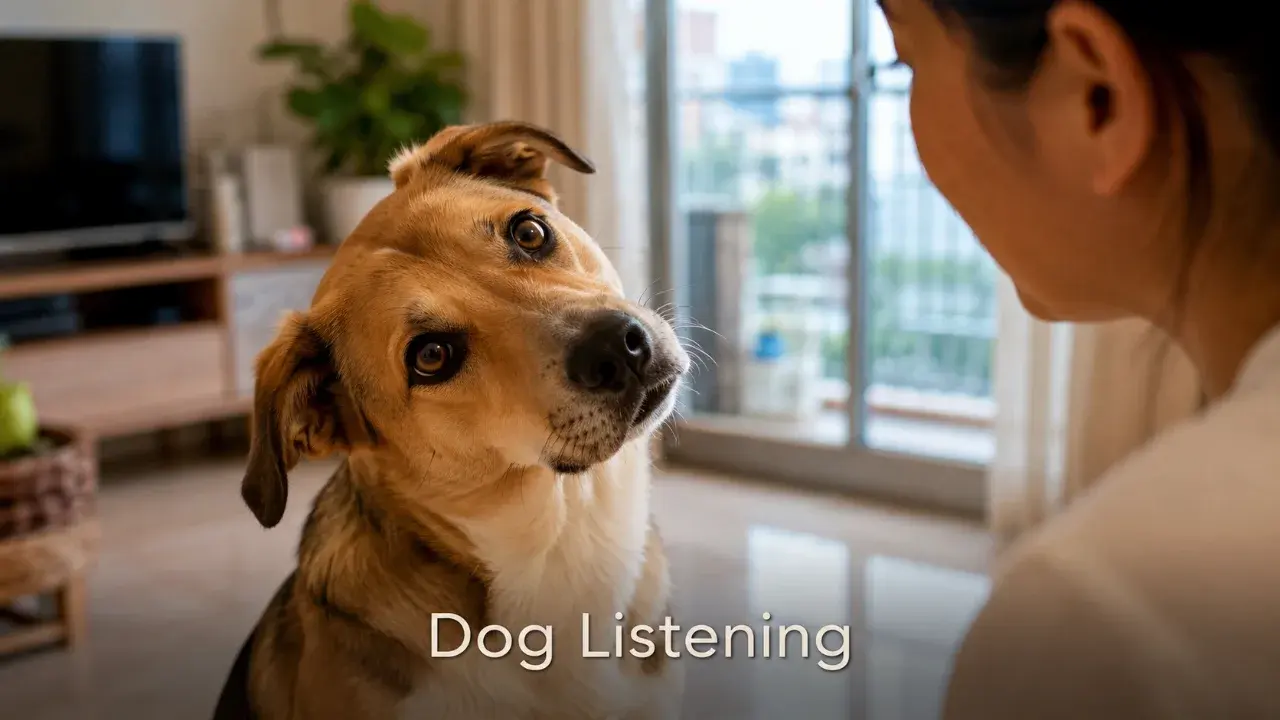
Your dog’s head tilt may look like pure cuteness, but it can also be a small sign of attention, communication, and problem-solving.
Say “walk,” “treat,” or your dog’s name, and the reaction can be instant. The ears lift. The eyes sharpen. The head tips slightly to one side, as if your dog is trying to decode the sentence.
In a way, that may be close to what is happening.
Scientists have not found one single explanation for every dog’s head tilt. Dogs vary by breed, body shape, personality, training, and daily routine. But research and veterinary behavior guidance point to a few likely reasons: dogs may tilt their heads to hear better, see a person’s face more clearly, focus on meaningful sounds, or keep an interaction going because people reward the gesture.
It is one of the smallest dog behaviors that can make a home feel like a two-way conversation.
Why the head tilt gets our attention
The head tilt is powerful because it feels human.
People often lean forward, nod, or change their posture when they are listening closely. A dog’s head tilt can look like the canine version of that: alert, engaged, and emotionally present.
Dogs do not understand human language in the same way people do. They are not following every word of a long sentence. But many dogs do learn that certain sounds, tones, gestures, and routines predict something important.
“Dinner” may mean food. “Leash” may mean the door. “Car” may mean a ride. A certain tone of voice may mean affection, play, or trouble.
That is why context matters. A dog tilting its head after a familiar word may be responding to a sound that has meaning. A dog tilting its head constantly, without a clear trigger, should be viewed differently.
It may help dogs listen more closely
One of the simplest explanations is hearing.
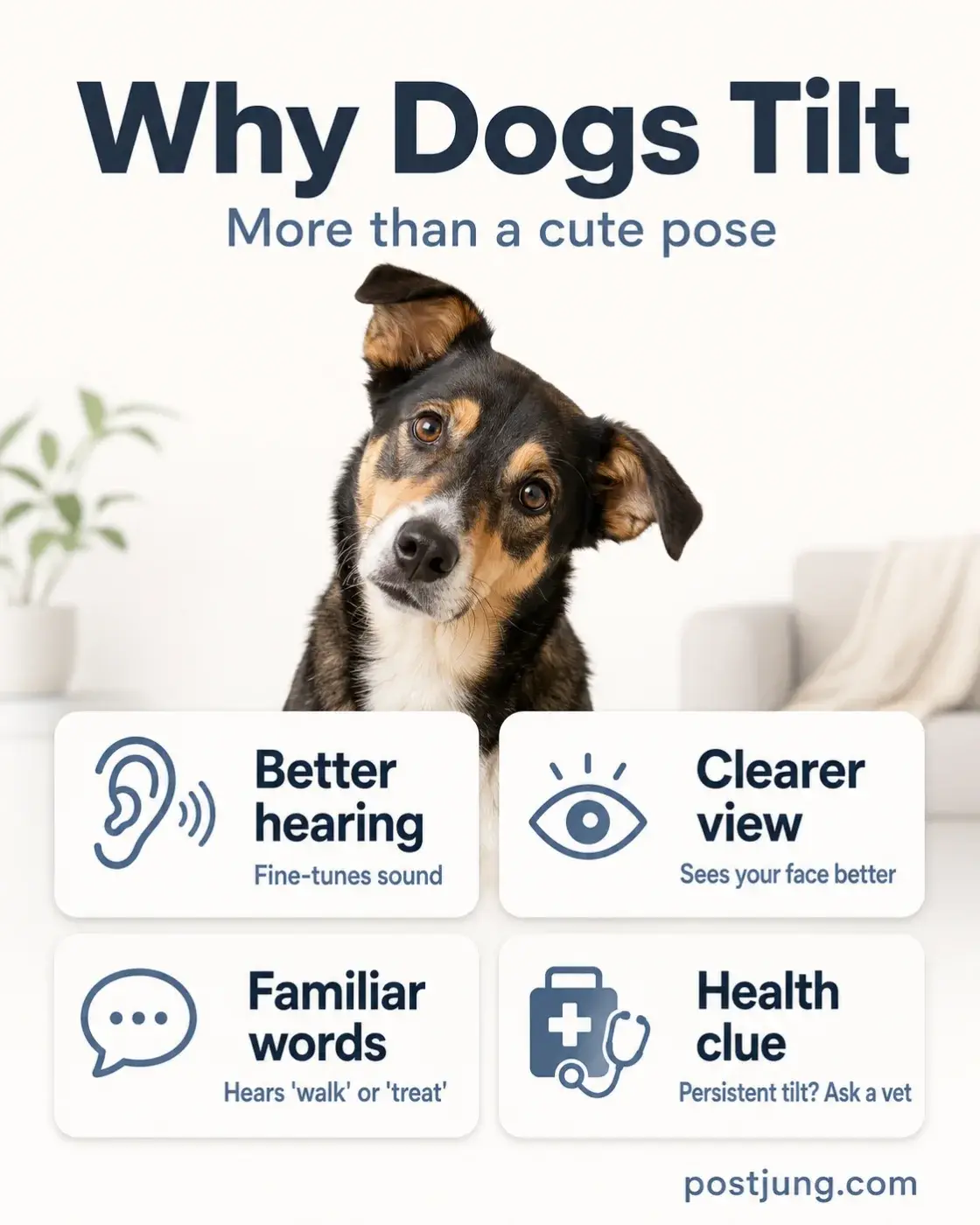
Dogs have movable ears, and small changes in head position may help them locate or process sounds more clearly. A dog may tilt its head when trying to understand where a sound is coming from or when focusing on a voice.
That does not mean your dog cannot hear you. It means the dog may be fine-tuning the signal.
Think of a person leaning toward someone across a noisy restaurant table. The movement is small, but it says, “I’m paying attention.”
For dogs, the listening process is even more layered. They may be responding to your words, tone, facial expression, body language, and the familiar rhythm of daily life all at once.
Your dog may be trying to see your face
The tilt may also be visual.
Many dogs have muzzles that partly block their view when they look up at a human face. Tilting the head can help some dogs see around their snout and get a better look at a person’s mouth, eyes, and expression.
This may explain why some dogs do it often while others rarely do. A long-muzzled dog may need a slightly different angle to see a human face than a flatter-faced dog. Ear shape, head shape, and individual habit can all affect the behavior.
A dog that never tilts its head is not less smart, less loving, or less connected to its owner. The behavior is charming, but it is not a universal test of canine intelligence.
Some head tilts may be linked to meaningful words
A small study published in Animal Cognition looked at dogs during object-name tests. Owners asked the dogs to fetch specific toys by name.
The researchers found that dogs who had learned toy names tilted their heads more often when hearing those meaningful names than typical dogs in the study. The researchers suggested that head tilting may be connected to attention and the processing of relevant sounds.
The important word is “may.”
The study does not prove that every head tilt means a dog understands human speech. It does not mean dogs are secretly following full conversations. It does suggest that, in some situations, a head tilt may happen when a dog is matching a familiar sound to a memory.
That fits what many owners see at home. A dog may ignore most of a sentence but react to one word inside it: “park,” “ball,” “outside,” “treat,” or the name of a favorite toy.
The dog is not translating every word. It may be spotting the one sound that matters.
The same habit crosses languages and cultures
For American readers, the familiar examples are words like “walk,” “ride,” “good boy,” or “treat.” But the behavior is not tied to English.
In Thailand, Southeast Asia, and multilingual homes around the world, dogs learn the sounds their own families use. A dog may respond to Thai words, English words, nicknames, hand signals, or the sound of a food container opening.
What matters most is consistency. Dogs are excellent pattern readers. If a sound reliably predicts food, play, movement, or affection, the dog may begin to treat that sound as important.
That is why the head tilt can feel so personal. It often appears at the exact moment when human language becomes part of a dog’s private map of the household.
Owners may accidentally train the behavior
There is another possibility: people may reinforce it.
Dogs repeat behaviors that work. If a dog tilts its head and the owner laughs, smiles, speaks sweetly, takes a photo, or gives extra attention, the dog may learn that the pose gets a positive response.
That does not make the behavior fake. It means dogs are social learners.
In many homes, the sequence is simple: the dog tilts, the human melts, and the dog notices.
Over time, some dogs may use the head tilt as part of their attention-seeking or communication style. It becomes less like a reflex and more like a tiny social tool.
When a head tilt should be checked
Most brief head tilts are normal. A dog hears something interesting, looks toward a person, tilts for a moment, then returns to normal.
A persistent tilt is different.
Veterinary guidance notes that a head tilt not linked to communication can sometimes point to ear infections, discomfort, neurological issues, or vestibular disease, which affects balance. Warning signs can include stumbling, circling, sudden disorientation, abnormal eye movements, vomiting, loss of balance, or reluctance to stand or walk.
That is the dividing line owners should remember: a curious tilt is usually temporary; a medical tilt may linger or appear with other symptoms.
If a dog keeps holding its head to one side, seems dizzy, acts confused, or looks uncomfortable, a veterinarian should evaluate it. This is general pet information, not a diagnosis, and a professional exam is the safest way to check the ears, balance system, and overall health.
The best way to read your dog’s head tilt
The easiest way to understand a head tilt is to look at the whole moment.
Did it happen after a familiar word? Was the dog relaxed and alert? Did the ears move? Was your dog watching your face? Did the tilt disappear quickly?
If yes, it may simply be one of those small, wonderful signs of attention that make dogs feel so connected to people.
If the tilt is sudden, constant, or paired with balance problems, it should not be treated as a cute habit.
For everyday dog owners, the best response is simple: enjoy the adorable moments, notice the patterns, and stay alert to changes.
Your dog may not understand the whole sentence.
But in that sideways pause, it may be trying very hard to understand you.
KEY TAKEAWAYS:
- A dog’s head tilt may involve hearing, vision, attention, learned behavior, or a mix of all four.
- Some research suggests head tilting may be linked to processing meaningful words in certain dogs.
- Owners may accidentally encourage the behavior by smiling, praising, or giving attention when it happens.
- A brief, responsive head tilt is usually different from a constant tilt with balance or discomfort signs.
- If a dog keeps its head tilted or seems dizzy, confused, or unsteady, a veterinarian should check it.
Animal Cognition, VCA Animal Hospitals, EurekAlert
References:
https://link.springer.com/article/10.1007/s10071-021-01571-8
https://vcahospitals.com/know-your-pet/why-dogs-tilt-their-heads
https://vcahospitals.com/know-your-pet/vestibular-disease-in-dogs

เขียนโดย Postjung Insights
 เปิดรายชื่อโรงเรียนในไทยที่ “ว่ายน้ำ” อยู่ในหลักสูตร เรียนจริงตั้งแต่อนุบาลถึงมัธยม
 โรงเรียนที่มีนักเรียนมากที่สุดในไทย
 รู้หรือไม่? เปิดรายได้พนักงานส่งพัสดุของแต่ละแอป วันหนึ่งได้เท่าไร
 อำเภอที่มีชื่ออำเภอสั้นที่สุด 3 อำเภอเท่านั้นในประเทศไทย
 Google ยอมรับแล้ว! Gemini AI เข้าถึงระบบบริษัทจริง 3 แห่ง ระหว่างการทดสอบความปลอดภัย
 5 คณะที่เรียนจบมาแล้ว มีอาชีพรองรับมากกว่าที่คิด
 จุฬาฯ มหาวิทยาลัยแห่งแรกของไทย มีจุดเริ่มต้นในสมัยรัชกาลที่ 5
 ตาราง “เด่นเหนือเด่นใต้” งวด 1 ต.ค. 69 เปิดข้อมูลตามโพย เลขไหนอยู่ตรงไหน
 เลขเด็ดปฏิทิน "หลวงปู่โต๊ะ" งวดวันที่ 1 ตุลาคม 69..ส่องเลย เลขไหนให้โชค!
 เปิด 5 โรงเรียนหญิงล้วนเก่าแก่ของไทย ที่มีประวัติยาวนานกว่าศตวรรษ
 ทำไมของพลาสติกเก่าบางชิ้นถึง “เหนียว” ขึ้นมาเอง ทั้งที่ไม่ได้เปื้อนอะไร?
 อุทยานเขาใหญ่เรียกตัว “ตีนผี” หลังขับจี้ช้างป่าพ่อลูก ลั่นระยะ 50 เมตรต้องจำให้ขึ้นใจ5 คณะที่เรียนจบมาแล้ว มีอาชีพรองรับมากกว่าที่คิดเปิดรายชื่อโรงเรียนในไทยที่ “ว่ายน้ำ” อยู่ในหลักสูตร เรียนจริงตั้งแต่อนุบาลถึงมัธยมGoogle ยอมรับแล้ว! Gemini AI เข้าถึงระบบบริษัทจริง 3 แห่ง ระหว่างการทดสอบความปลอดภัยเลขเด็ดปฏิทิน "หลวงปู่โต๊ะ" งวดวันที่ 1 ตุลาคม 69..ส่องเลย เลขไหนให้โชค!ทำไมของพลาสติกเก่าบางชิ้นถึง “เหนียว” ขึ้นมาเอง ทั้งที่ไม่ได้เปื้อนอะไร?อุทยานเขาใหญ่เรียกตัว “ตีนผี” หลังขับจี้ช้างป่าพ่อลูก ลั่นระยะ 50 เมตรต้องจำให้ขึ้นใจ
 English Edition