Why Your Cat Stares at Nothing at Night
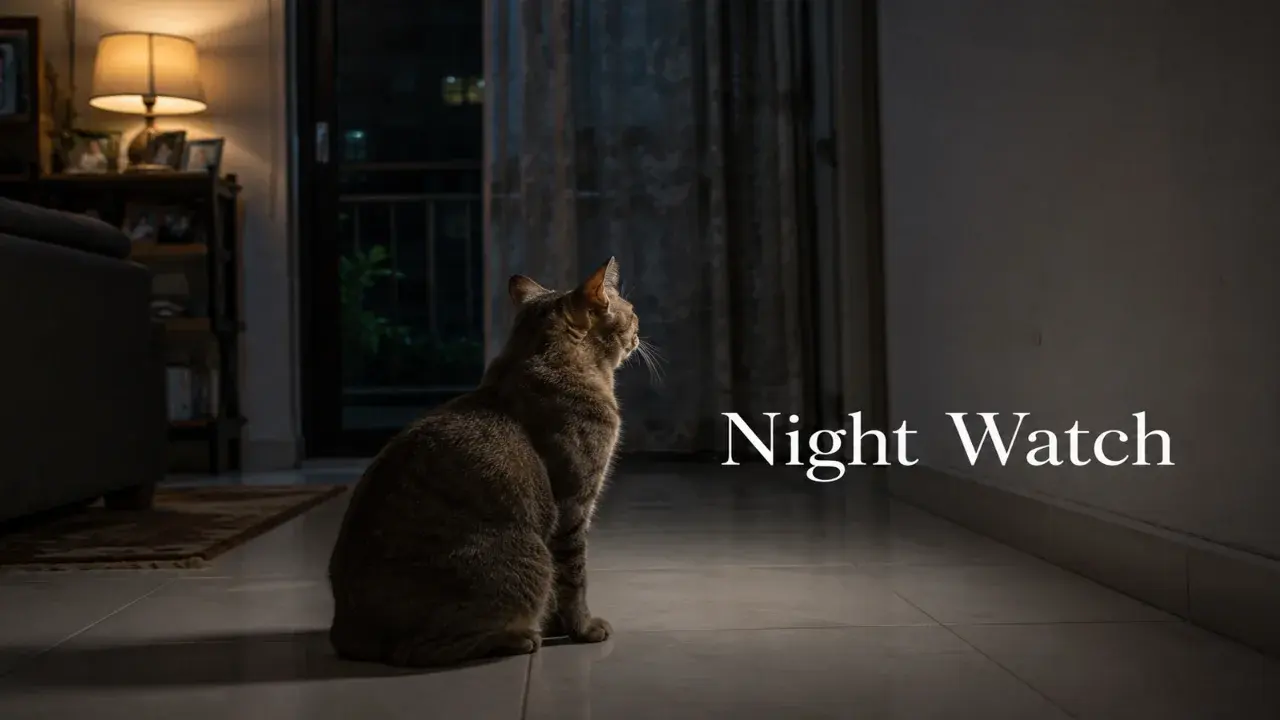
That eerie late-night stare is usually not a sign of anything supernatural. It is often your cat’s sharper senses picking up tiny sounds, movements, or changes you missed.
Your cat may not be staring at nothing. It may be noticing something too small, quiet, or quick for you to catch.
It is one of the strangest little moments of living with a cat. The room is dark. The house is still. Then your cat suddenly sits upright, locks its eyes on a blank wall or empty corner, and watches as if something important is happening there.
To a sleepy human, it can feel unsettling. To a cat, it may be ordinary.
The most likely explanation is not mysterious at all: cats experience the same room with much sharper tools. Their vision, hearing, whiskers, and hunting instincts are built to detect small changes. What looks like an empty hallway to you may be full of tiny signals to them.
The room is not as empty as it looks
Humans tend to judge a room by what we can clearly see. Cats do not rely on human-level evidence.
A tiny insect near the ceiling, a spider along the baseboard, a shadow from a passing car, or a reflection from a phone screen can all become interesting to a cat. Even a faint movement in a curtain may be enough to trigger focus.
Cats are also better adapted to dim light than people are. Their eyes have a reflective layer behind the retina called the tapetum lucidum, which helps improve light sensitivity in low-light conditions. That does not mean cats can see in total darkness, but it does help explain why they may notice movement in a room that looks nearly still to us.
So when your cat fixes its gaze on a dark corner, it may not be staring into space. It may be watching a tiny target with impressive patience.
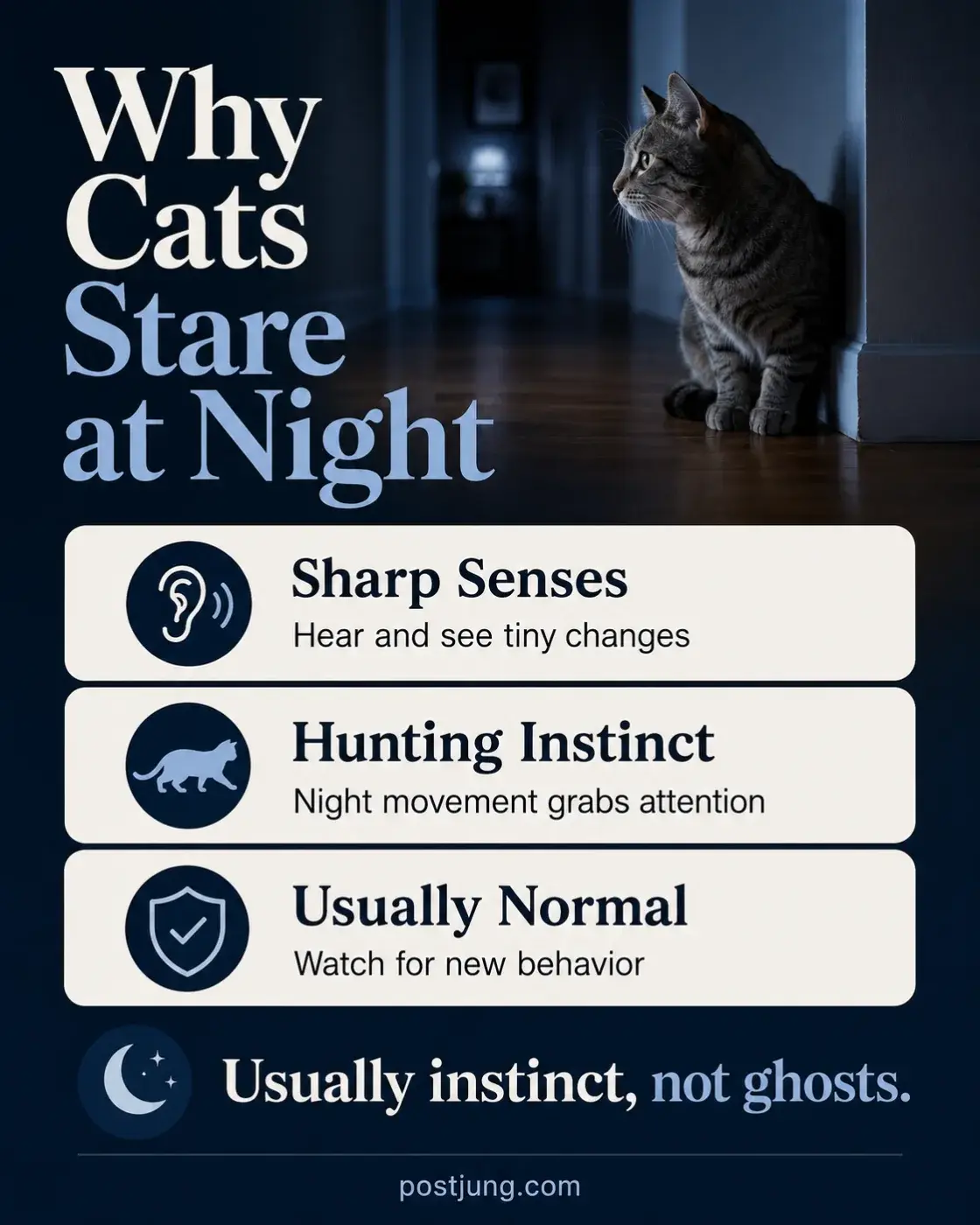
Sometimes the stare starts with a sound
A cat’s eyes may point at the wall because its ears found something first.
Cats can react to small household noises that humans overlook: pipes, vents, insects, electronics, settling wood, footsteps outside, or activity in a neighboring apartment. In a quiet room at night, those sounds can seem louder and more meaningful to a cat.
That is why wall-staring can look so strange. The cat appears completely focused, but the human sees no proof. The evidence may be auditory, not visual.
If your cat tilts its ears, shifts its head, or tracks one spot with sharp attention, it may be listening more than watching.
The hunting brain wakes up at quiet hours
Indoor cats may sleep through much of the day, then become more alert when the house settles down. Low-light hours can bring out old hunting patterns, even in cats that have never had to catch dinner.
A hallway becomes a path. A shadow becomes movement. A paper bag becomes cover. A tiny bug becomes tonight’s main event.
This is why the stare may be followed by a tail twitch, a crouch, a chirp, or a sudden pounce. The cat is not trying to scare you. It is doing what cats do: waiting, calculating, and deciding whether something is worth chasing.
For owners, the useful question is not only “What is my cat staring at?” It is also “Does my cat have enough to do?”
A bored indoor cat may turn every sound into an investigation. Evening play with a wand toy, a puzzle feeder, a climbing spot, or a safe window view can help give that alert brain a better outlet before bedtime.
The biggest misunderstanding
The common mistake is assuming that staring at nothing means something is wrong.
Most of the time, it does not. Cats pause and stare because they are gathering information. Their body language can look intense because their attention is intense.
Cats are observers by design. They notice details because noticing details is part of how a small predator survives.
Still, “usually normal” does not mean “always ignore it.”
Pay attention if the staring is new, frequent, difficult to interrupt, or paired with other changes. Warning signs may include confusion, bumping into furniture, unusual night crying, loss of appetite, hiding, litter box changes, poor grooming, aggression, or signs of pain.
This is especially important for senior cats. Older cats can develop behavior changes linked to pain, vision or hearing issues, anxiety, cognitive changes, thyroid disease, or other medical problems. A stare alone is not a diagnosis, but a clear change in behavior deserves attention.
A helpful rule: normal staring comes and goes. Concerning staring tends to be new, repetitive, hard to interrupt, or part of a bigger pattern.
Why it feels so universal
Cat owners around the world recognize this scene.
In a U.S. apartment, a cat may focus on a heating vent, basement door, window screen, or shared wall. In Thailand or other parts of Southeast Asia, the mystery may be a mosquito, gecko, ceiling fan shadow, balcony sound, or small house lizard moving near the wall.
The details change from place to place, but the cat logic stays familiar. Humans see a quiet home. Cats read the room like a living map.
That is part of why cats can feel both funny and mysterious. They remind us that our version of reality is not the only one in the room.
When to relax
If your cat looks alert, responsive, and otherwise normal, a late-night stare is usually not a reason to panic. Call its name, offer a toy, or gently make a sound. A healthy cat will often react, even if it chooses to keep monitoring the corner.
If the behavior worries you, record a short video. It can help a veterinarian see exactly what you mean instead of relying on a vague description like “my cat stares at nothing.”
Most of the time, though, the explanation is simple and very cat-like.
Your cat may not be seeing ghosts. It may just be hearing a pipe, watching a bug, tracking a shadow, or noticing a small piece of the world before you do.
KEY TAKEAWAYS:
- Cats often stare at “nothing” because they notice tiny sounds, movements, or shadows humans miss.
- Their low-light vision and sharp hearing can make a quiet room feel much more active to them.
- The behavior is usually normal if the cat is alert, responsive, and otherwise acting like itself.
- New, frequent, trance-like staring or behavior changes may be worth discussing with a veterinarian.
- Evening play and enrichment can help indoor cats use their alert nighttime energy in healthier ways.
VCA Animal Hospitals, Cornell Feline Health Center, ASPCA
References:
https://vcahospitals.com/resources/behavior-cat/why-do-cats-stare-at-nothing
https://www.vet.cornell.edu/departments-centers-and-institutes/cornell-feline-health-center/health-information/feline-health-topics/feline-vision-problems-host-possible-causes
https://www.aspca.org/pet-care/cat-care/common-cat-behavior-issues/older-cats-behavior-problems

เขียนโดย Postjung Insights
 รู้หรือไม่? เปิดรายได้พนักงานส่งพัสดุของแต่ละแอป วันหนึ่งได้เท่าไร
 อินฟลูเอนเซอร์สาวผู้สร้างคอนเทนต์สำหรับผู้ใหญ่และมีรายได้ต่อปีกว่า 33 ล้านบาท ตัดสินใจเปลี่ยนอาชีพมาเป็นแพทย์แทน
 ฝูงลิงญี่ปุ่นนับสิบรุมล้อมและโจมตีชายคนหนึ่งในคานากาวะ
 ยูเครนขอจัดการประชุมสุดยอดกับญี่ปุ่น
 เปิด 5 โรงเรียนหญิงล้วนเก่าแก่ของไทย ที่มีประวัติยาวนานกว่าศตวรรษ
 ตึกยาวสวนกุหลาบฯ อายุเกิน 100 ปี ทำไมยังใช้เป็นห้องเรียนมาถึงวันนี้
 แปลปกสลาก งวด 1 ต.ค. 69 ส่องตัวเลขจากภาพปกสลากกินแบ่งรัฐบาล
 ส่องเลข 3 สำนักพิมพ์ งวด 1 ต.ค. 69 ตัวไหนมีข้อมูลตรงกัน
 หัวลูกศรหินย้อนเวลา 80,000 ปี ในเอเชียกลาง… หลักฐานใหม่ชี้ โฮโม เซเปียนส์ อาจเคยบุกยุโรปเร็วขึ้นนับหมื่นปี!
 อำเภอที่มีชื่ออำเภอสั้นที่สุด 3 อำเภอเท่านั้นในประเทศไทย
 ถ้าไม่กลัวเหนื่อย 7 อาชีพที่ตลาดยังต้องการ และค่าทักษะไปถึง 800 บาท/วัน
 โรงเรียนที่มีนักเรียนมากที่สุดในไทยเปิด 5 โรงเรียนหญิงล้วนเก่าแก่ของไทย ที่มีประวัติยาวนานกว่าศตวรรษหัวลูกศรหินย้อนเวลา 80,000 ปี ในเอเชียกลาง… หลักฐานใหม่ชี้ โฮโม เซเปียนส์ อาจเคยบุกยุโรปเร็วขึ้นนับหมื่นปี!ถ้าไม่กลัวเหนื่อย 7 อาชีพที่ตลาดยังต้องการ และค่าทักษะไปถึง 800 บาท/วัน
 ทำไมแผนที่ส่วนใหญ่เอาทิศเหนือไว้ด้านบน ทั้งที่โลกไม่มี “ด้านบน” จริง ๆ?
 English Edition