Why Thai Breakfast Says So Much About Everyday Life in Thailand
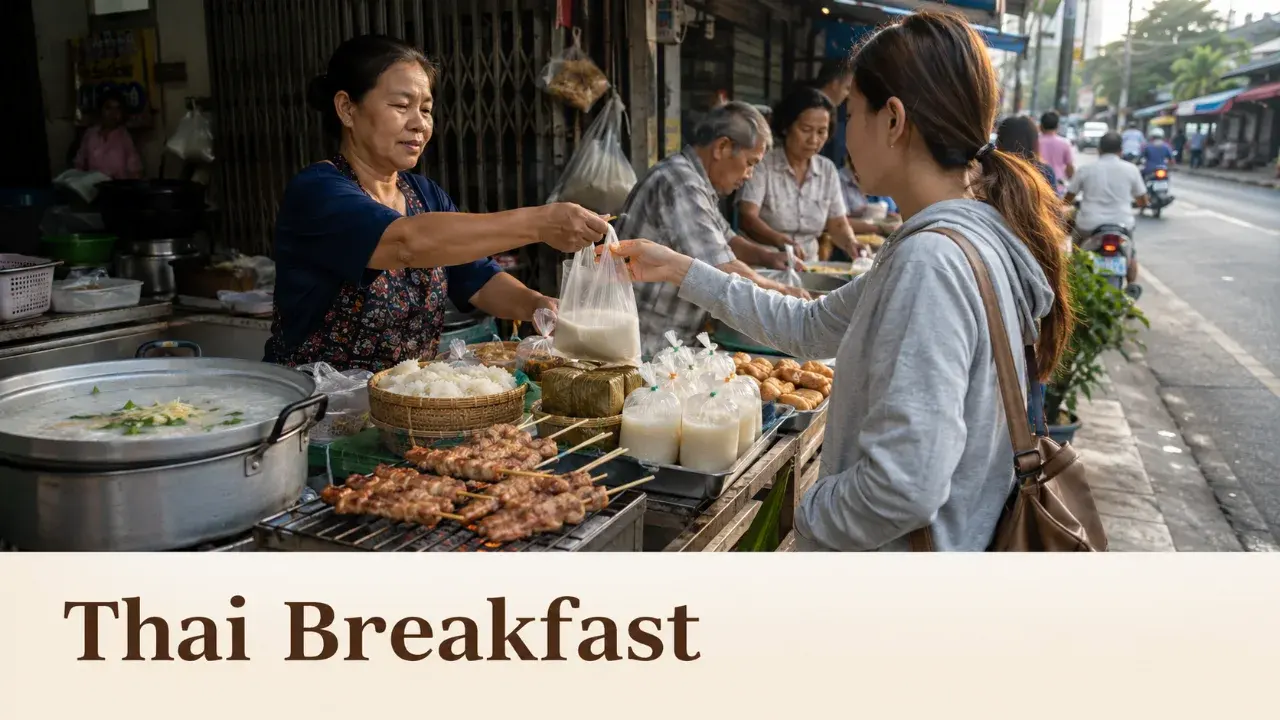
Thai breakfast is not just a morning meal. From rice porridge to grilled pork skewers, it shows how comfort, convenience, street food, and community shape daily life in Thailand.
A Thai morning often starts on the sidewalk.
Before office towers fill up and before the heat settles in, breakfast is already being served from metal pots, charcoal grills, plastic bags, folding tables, and market stalls. Rice soup steams beside busy roads. Pork skewers smoke over small grills. Soy milk is poured into bags and tied with rubber bands. People eat quickly before school, work, errands, traffic, and the day’s first rush.
For many visitors, Thai breakfast can be surprising because it does not always look like “breakfast” in the American sense. It may be savory. It may be spicy. It may come with rice. It may look like something Americans would expect at lunch or dinner.
That is exactly why it tells such a useful story.
Thai breakfast is not only about food. It reveals how everyday life in Thailand works: practical, flexible, social, and closely connected to street vendors, rice, early schedules, and neighborhood routines.
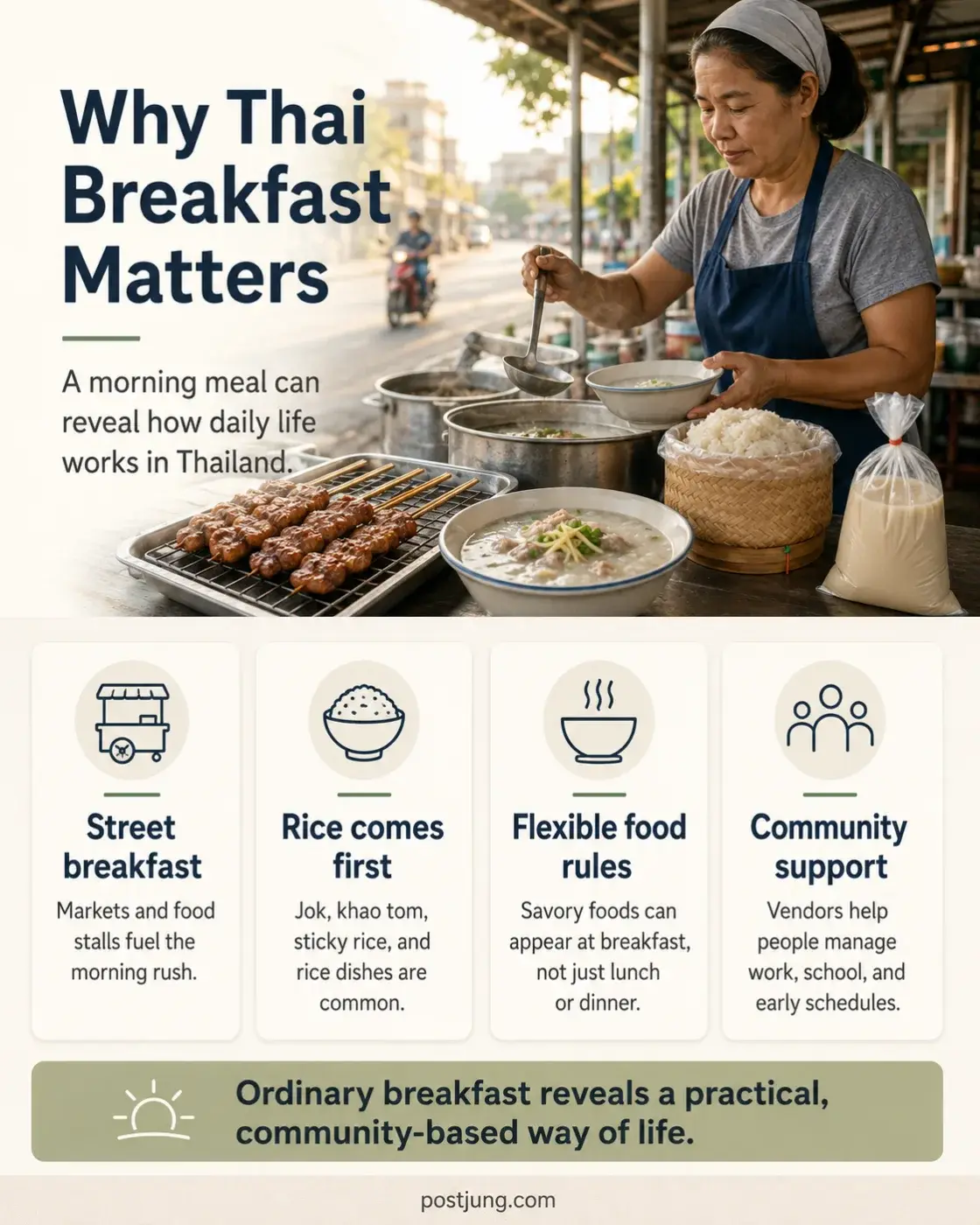
Breakfast often happens outside the home
In the United States, breakfast is often imagined as something prepared at home or bought from a coffee shop or drive-through: cereal, toast, eggs, yogurt, pancakes, breakfast sandwiches, or coffee on the way to work.
In Thailand, breakfast often belongs to the street.
That does not mean Thai families never cook in the morning. Many do. But in cities, towns, and market neighborhoods, buying breakfast outside is normal, convenient, and deeply woven into daily life.
A person might stop for grilled pork with sticky rice before work. A parent might buy rice porridge for a child before school. Someone else might pick up soy milk and patongo, Thai-style fried dough, from a morning vendor.
The meal is quick, but the habit is not random.
Food stalls make the morning easier for people with long commutes, early work shifts, small kitchens, or little time to cook before leaving home. In that sense, a good breakfast vendor is more than a place to buy food. It is part of the neighborhood’s daily support system.
Rice is the center of the morning
To understand Thai breakfast, start with rice.
Rice is central to Thai meals, and that includes breakfast. Instead of treating the morning as a completely separate food category, Thai eating habits often make room for the same core idea found throughout the day: rice with something warm, savory, filling, or easy to carry.
Two common examples are jok and khao tom.
Jok is a thick rice porridge, soft and smooth, often served hot with pork, egg, ginger, cilantro, scallions, and white pepper. It is the kind of dish that feels gentle but satisfying, especially early in the day.
Khao tom is thinner and more soup-like. The rice grains remain more visible, floating in broth with pork, fish, shrimp, garlic, or other ingredients. It can feel light, warm, and comforting without being bland.
These dishes show one of the clearest truths about Thai breakfast: comfort matters.
A bowl of hot rice soup is not trying to impress anyone. It is not a food-poster moment. It is practical, familiar, and easy to eat before the day gets busy.
Thai breakfast is more flexible than outsiders expect
One common misunderstanding is that Thailand has one fixed set of breakfast foods.
It does not.
Some foods are strongly associated with the morning, including jok, khao tom, patongo, soy milk, soft-boiled eggs, and grilled pork with sticky rice. But many foods that appear at lunch or dinner can also show up at breakfast.
Rice and curry in the morning can be normal. A Thai omelet over rice is common. Grilled chicken with sticky rice is easy to find. Noodles can also work.
For American readers, this may be the biggest culture shift. In the U.S., breakfast foods are often clearly separated from lunch and dinner foods. Pancakes, cereal, waffles, bacon, eggs, and breakfast sandwiches feel tied to the morning. Curry or grilled chicken at 7 a.m. may feel unusual.
Thailand is more relaxed about the boundary.
The question is not always, “Is this breakfast food?” It is more often, “Is this available, filling, affordable, and right for now?”
That small difference says a lot about Thai daily life. Meals often adapt to time, heat, budget, work, school, and convenience rather than strict categories.
Morning food follows real schedules
Thailand’s breakfast culture also reflects the rhythm of the day.
In many places, life starts early. Market vendors set up before sunrise. Students leave home early. Office workers face traffic. Monks make morning alms rounds. Delivery riders, shop owners, and commuters move through the same streets before the day becomes hotter and busier.
Breakfast has to fit that pace.
Moo ping, grilled pork skewers often eaten with sticky rice, is one of the clearest examples. It is portable, filling, and quick. The sticky rice usually comes in a small bag. The pork is smoky, savory, slightly sweet, and easy to eat on the move.
For a traveler, moo ping can feel like a street food discovery. For many local people, it is simply breakfast that works.
The same is true for soy milk and patongo. A vendor can serve many customers quickly. People can eat at a small table, carry breakfast home, or take it to work.
This is why Thai street food should not be seen only as a tourist attraction. In daily life, it often functions like informal infrastructure.
The ordinary meal tells the bigger story
Visitors often arrive in Thailand looking for famous dishes: pad Thai, tom yum, green curry, mango sticky rice.
Those foods matter, but they do not fully explain how people live.
Breakfast often does.
Morning meals are less performative. They are not designed around travel brochures or restaurant rankings. They are there to feed people before the day begins.
A bowl of jok shows the appeal of warm, soft, soothing food. A bag of sticky rice shows how portable rice can be. A morning curry stall shows how flexible mealtimes are. Iced coffee from a street cart shows how older habits and modern work routines sit side by side.
This is the quiet power of breakfast in Thailand. It makes ordinary life visible.
The hidden context is community
Thai breakfast also reveals how social everyday eating can be.
Even when people are in a hurry, they may return to the same vendor again and again. A vendor may remember how a customer likes their porridge, whether they want an egg, or how much chili they usually add.
That relationship is easy to miss if street food is seen only as cheap food.
In many Thai neighborhoods, food vendors act as anchors. They save people time. They feed students, workers, elders, commuters, and families. They create routine in places that may otherwise feel busy, crowded, or unpredictable.
For global readers, especially Americans more familiar with home kitchens, breakfast chains, or drive-through routines, this offers a different way to think about convenience.
Thai breakfast is not only a meal. It is a small daily exchange between people, place, and habit.
What travelers should know
For visitors, Thai breakfast is one of the easiest ways to understand real daily life.
You do not need a famous restaurant. A morning market, a neighborhood stall, or a small shop selling jok or khao tom may teach you more than a polished brunch spot.
Go early. Many morning vendors sell out or close before late morning.
Look for places with steady local customers. That usually says more than decorations, English menus, or social media popularity.
Do not assume breakfast must be sweet or mild. Some Thai breakfasts are gentle, but others are salty, garlicky, smoky, spicy, or deeply savory.
Most of all, be open to rice.
In Thailand, rice is not just a side dish. It is often the center of the meal, including the first meal of the day.
A Thai breakfast can be a bowl of rice soup, pork skewers with sticky rice, an omelet over rice, a cup of soy milk, fried dough, noodles, or a small bag of sweets from a market.
Simple food. Early food. Often hurried food.
But inside that routine is a clear picture of Thailand: practical, adaptable, community-based, and always close to something good to eat.
KEY TAKEAWAYS:
- Thai breakfast often happens outside the home, especially around markets, schools, offices, and transport routes.
- Rice is central to many Thai morning meals, including jok, khao tom, sticky rice, and rice with omelets or curry.
- Thailand does not separate breakfast foods from lunch and dinner foods as strictly as many Americans may expect.
- Morning vendors are part of daily neighborhood life, not just a tourist food scene.
- For travelers, ordinary breakfast stalls can reveal more about Thailand than famous restaurant dishes.
Tourism Authority of Thailand, Eating Thai Food
References:
https://tourismthailand.my/about_thaifood.php
https://www.eatingthaifood.com/thai-breakfast-food-dishes/

เขียนโดย Postjung Insights
 โรงเรียนที่มีนักเรียนมากที่สุดในไทย
 รู้หรือไม่? เปิดรายได้พนักงานส่งพัสดุของแต่ละแอป วันหนึ่งได้เท่าไร
 Google ยอมรับแล้ว! Gemini AI เข้าถึงระบบบริษัทจริง 3 แห่ง ระหว่างการทดสอบความปลอดภัย
 5 คณะที่เรียนจบมาแล้ว มีอาชีพรองรับมากกว่าที่คิด
 ตาราง “เด่นเหนือเด่นใต้” งวด 1 ต.ค. 69 เปิดข้อมูลตามโพย เลขไหนอยู่ตรงไหน
 อำเภอที่มีชื่ออำเภอสั้นที่สุด 3 อำเภอเท่านั้นในประเทศไทย
 ทำไมของพลาสติกเก่าบางชิ้นถึง “เหนียว” ขึ้นมาเอง ทั้งที่ไม่ได้เปื้อนอะไร?
 เปิดรายชื่อโรงเรียนในไทยที่ “ว่ายน้ำ” อยู่ในหลักสูตร เรียนจริงตั้งแต่อนุบาลถึงมัธยม
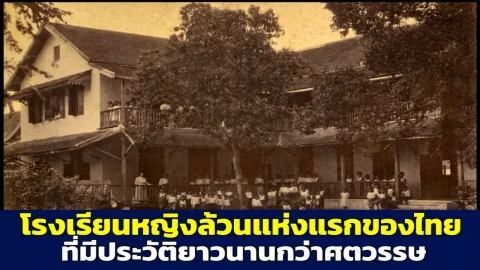 เปิด 5 โรงเรียนหญิงล้วนเก่าแก่ของไทย ที่มีประวัติยาวนานกว่าศตวรรษ
 อุทยานเขาใหญ่เรียกตัว “ตีนผี” หลังขับจี้ช้างป่าพ่อลูก ลั่นระยะ 50 เมตรต้องจำให้ขึ้นใจ
 เลขเด็ดปฏิทิน "หลวงปู่โต๊ะ" งวดวันที่ 1 ตุลาคม 69..ส่องเลย เลขไหนให้โชค!
 จุฬาฯ มหาวิทยาลัยแห่งแรกของไทย มีจุดเริ่มต้นในสมัยรัชกาลที่ 55 คณะที่เรียนจบมาแล้ว มีอาชีพรองรับมากกว่าที่คิดเปิดรายชื่อโรงเรียนในไทยที่ “ว่ายน้ำ” อยู่ในหลักสูตร เรียนจริงตั้งแต่อนุบาลถึงมัธยมGoogle ยอมรับแล้ว! Gemini AI เข้าถึงระบบบริษัทจริง 3 แห่ง ระหว่างการทดสอบความปลอดภัยเลขเด็ดปฏิทิน "หลวงปู่โต๊ะ" งวดวันที่ 1 ตุลาคม 69..ส่องเลย เลขไหนให้โชค!ทำไมของพลาสติกเก่าบางชิ้นถึง “เหนียว” ขึ้นมาเอง ทั้งที่ไม่ได้เปื้อนอะไร?อุทยานเขาใหญ่เรียกตัว “ตีนผี” หลังขับจี้ช้างป่าพ่อลูก ลั่นระยะ 50 เมตรต้องจำให้ขึ้นใจ
 English Edition