Why “Mai Pen Rai” Means More Than “No Worries” in Thailand
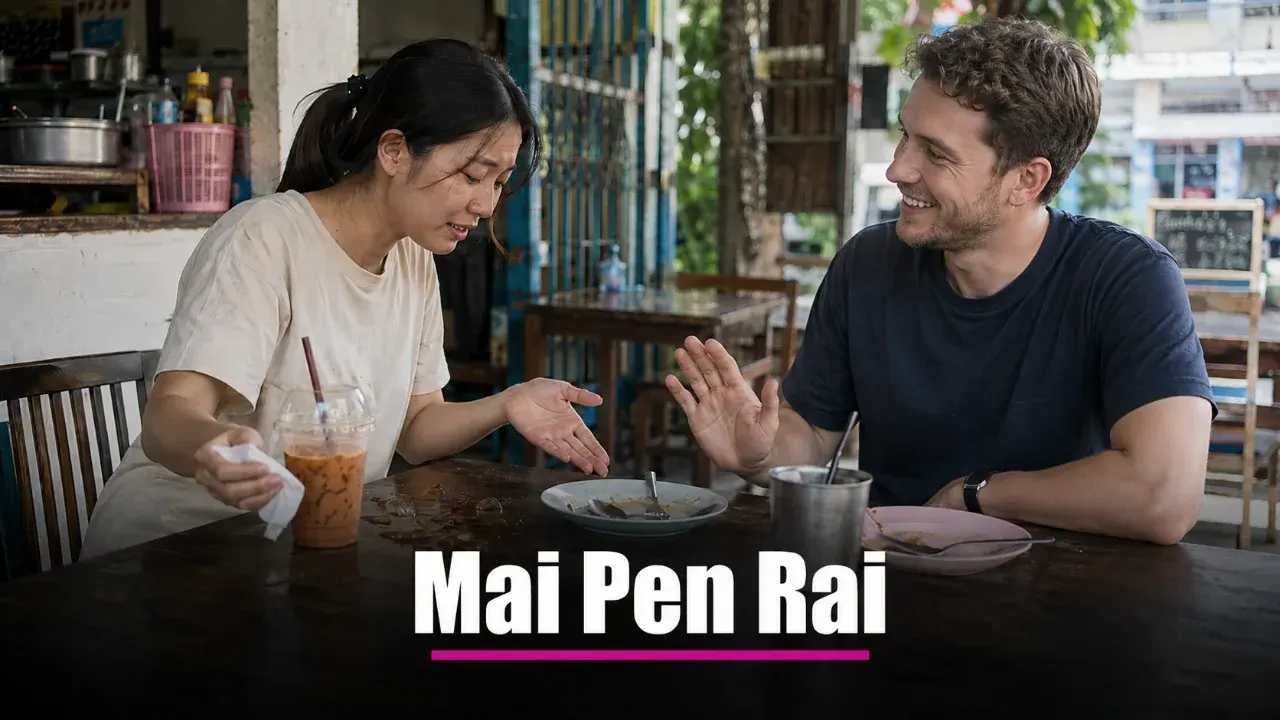
The famous Thai phrase is often translated as “it’s okay,” but in daily life it can soften embarrassment, avoid conflict, and keep small problems from becoming bigger ones.
A spilled drink, a late taxi, a wrong order at a food stall — in Thailand, these small moments are often met with three familiar words: mai pen rai.
Visitors usually hear it as “no worries.” That is close enough to be useful, but not close enough to explain why the phrase matters.
Mai pen rai is one of Thailand’s most recognizable everyday expressions. Thai-language references define it across several meanings, including “never mind,” “you’re welcome,” “don’t mention it,” and “it’s no big deal.”
In real life, though, the phrase is not only about translation. It is about mood, timing, and social comfort.
A phrase that lowers the temperature
To understand mai pen rai, imagine a normal day in Thailand.
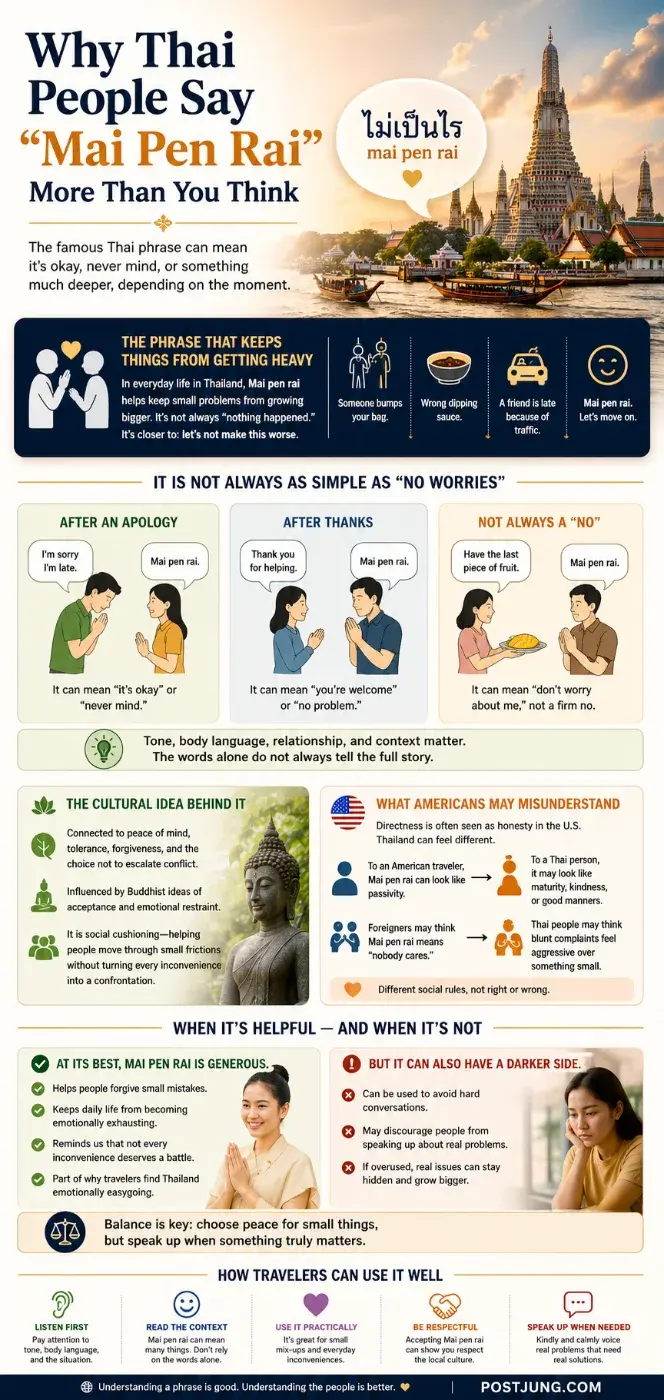
Someone bumps your bag on a crowded train. A friend arrives late because Bangkok traffic is moving at its usual crawl. A server brings the wrong dipping sauce with your meal. In many casual situations, a Thai person may smile lightly and say mai pen rai.
The message is not always “nothing happened.” It is often closer to “let’s not make this heavier than it needs to be.”
That difference matters.
Mai pen rai does not mean Thai people never get annoyed or never care about mistakes. It means that in many everyday situations, especially small ones, open irritation can feel unnecessary, uncomfortable, or too direct.
The phrase works like social cushioning. It gives people a way to move past a small problem without embarrassing anyone.
Why it can confuse foreigners
English speakers often look for one clean meaning. Thai communication can depend more heavily on tone, body language, relationship, and context.
Mai pen rai can be used after an apology.
“I’m sorry I’m late.”
“Mai pen rai.”
It can also be used after thanks.
“Thank you for helping me.”
“Mai pen rai.”
In that setting, it may mean something like “don’t mention it” or “you’re welcome.”
But the phrase can also appear when someone does not want to trouble another person. If a Thai friend is offered the last piece of fruit, they might say mai pen rai even if they would not mind having it.
In that case, the meaning may be closer to “don’t worry about me” than a hard “no.”
That is why visitors should avoid treating the phrase like a simple button they can press in every situation. The words matter, but the moment matters more.
The cultural idea behind it
Thailand Foundation describes mai pen rai as a phrase tied to compassion, emotional resilience, mutual understanding, and social harmony, rather than simple indifference.
Academic discussion has also treated the phrase as part of everyday Thai communication, not just a vocabulary item. A paper in MANUSYA, a humanities journal associated with Chulalongkorn University, describes mai pen rai as a frequent Thai expression with several communicative functions in real conversations.
For global readers, the easiest way to understand it may be this: mai pen rai helps people manage small frictions gracefully.
It can protect someone from losing face. It can keep a public mistake from becoming awkward. It can signal that a person is choosing calm over confrontation.
That does not mean problems disappear. It means the first response is often to preserve the relationship and the mood.
What Americans may misunderstand
For many Americans, directness is often treated as honesty. If something is wrong, you say it. If you want something, you ask. If a service problem happens, you explain it clearly.
Thailand can feel different.
A Thai person may avoid making someone feel publicly blamed. They may soften disappointment rather than state it bluntly. They may use a smile, silence, humor, or mai pen rai to keep the situation smooth.
To an American traveler, that can look passive. To a Thai person, it may look polite, mature, or emotionally controlled.
The misunderstanding can go both ways. Foreigners may think mai pen rai means “nobody cares.” Thai people may find blunt complaints aggressive when the issue is minor.
Neither reaction is automatically right. They come from different social habits.
When “mai pen rai” is helpful — and when it is not
At its best, mai pen rai is generous.
It helps people forgive small mistakes. It keeps everyday life from becoming emotionally exhausting. It reminds people that not every inconvenience deserves a full argument.
That is one reason many travelers experience Thailand as emotionally easygoing. A tiny mix-up may be met with a smile instead of a lecture.
But there is another side.
If used too broadly, mai pen rai can make real problems harder to address. In work, relationships, safety, money, or accountability issues, brushing things aside may not solve the problem. Prachatai English has also noted that the phrase can be misunderstood when people treat it as a blanket explanation for Thai behavior.
So the better reading is not “ignore everything.”
It is: do not turn small problems into big ones — but know when something is no longer small.
How visitors can use it respectfully
Visitors can say mai pen rai, but they should use it lightly.
It works best when someone apologizes for a small inconvenience, when you want to say “no problem,” or when you are responding warmly to thanks.
Say it naturally, not as a performance.
It is less useful when someone is genuinely upset, when money or safety is involved, or when the other person needs a clear answer. In those moments, direct kindness is better than a phrase used too casually.
A good rule is simple: use mai pen rai when you are truly letting something go, not when you are avoiding responsibility.
That is the heart of the phrase.
Mai pen rai is not just Thai for “whatever.” It is a small piece of social wisdom: life is full of minor mistakes, and not all of them deserve our full anger.
Sometimes the most graceful answer is to breathe, smile, and let the moment pass.
KEY TAKEAWAYS:
- Mai pen rai is often translated as “no worries,” but its meaning depends on context.
- The phrase can mean “it’s okay,” “never mind,” “you’re welcome,” or “don’t worry about it.”
- In Thai culture, it often helps soften embarrassment and avoid unnecessary conflict.
- Visitors can use it for small, casual situations, but not to dismiss serious problems.
- The phrase is best understood as social cushioning, not indifference.
Thailand Foundation, Thai-language.com, Chulalongkorn University MANUSYA Journal, Prachatai English
References:
https://thailandfoundation.or.th/understanding-mai-pen-rai/
https://www.thai-language.com/id/196822
https://digital.car.chula.ac.th/manusya/vol6/iss1/3/

เขียนโดย Postjung Insights
 รู้หรือไม่? เปิดรายได้พนักงานส่งพัสดุของแต่ละแอป วันหนึ่งได้เท่าไร
 5 คณะที่เรียนจบมาแล้ว มีอาชีพรองรับมากกว่าที่คิด
 เปิดรายชื่อโรงเรียนในไทยที่ “ว่ายน้ำ” อยู่ในหลักสูตร เรียนจริงตั้งแต่อนุบาลถึงมัธยม
 โรงเรียนที่มีนักเรียนมากที่สุดในไทย
 แปลปกสลาก งวด 1 ต.ค. 69 ส่องตัวเลขจากภาพปกสลากกินแบ่งรัฐบาล
 อำเภอที่มีชื่ออำเภอสั้นที่สุด 3 อำเภอเท่านั้นในประเทศไทย
 ตาราง “เด่นเหนือเด่นใต้” งวด 1 ต.ค. 69 เปิดข้อมูลตามโพย เลขไหนอยู่ตรงไหน
 ทำไมของพลาสติกเก่าบางชิ้นถึง “เหนียว” ขึ้นมาเอง ทั้งที่ไม่ได้เปื้อนอะไร?
 อุทยานเขาใหญ่เรียกตัว “ตีนผี” หลังขับจี้ช้างป่าพ่อลูก ลั่นระยะ 50 เมตรต้องจำให้ขึ้นใจ
 Google ยอมรับแล้ว! Gemini AI เข้าถึงระบบบริษัทจริง 3 แห่ง ระหว่างการทดสอบความปลอดภัย
 เลขเด็ดปฏิทิน "หลวงปู่โต๊ะ" งวดวันที่ 1 ตุลาคม 69..ส่องเลย เลขไหนให้โชค!
 เปิด 5 โรงเรียนหญิงล้วนเก่าแก่ของไทย ที่มีประวัติยาวนานกว่าศตวรรษ5 คณะที่เรียนจบมาแล้ว มีอาชีพรองรับมากกว่าที่คิดเปิดรายชื่อโรงเรียนในไทยที่ “ว่ายน้ำ” อยู่ในหลักสูตร เรียนจริงตั้งแต่อนุบาลถึงมัธยมGoogle ยอมรับแล้ว! Gemini AI เข้าถึงระบบบริษัทจริง 3 แห่ง ระหว่างการทดสอบความปลอดภัยเลขเด็ดปฏิทิน "หลวงปู่โต๊ะ" งวดวันที่ 1 ตุลาคม 69..ส่องเลย เลขไหนให้โชค!ทำไมของพลาสติกเก่าบางชิ้นถึง “เหนียว” ขึ้นมาเอง ทั้งที่ไม่ได้เปื้อนอะไร?อุทยานเขาใหญ่เรียกตัว “ตีนผี” หลังขับจี้ช้างป่าพ่อลูก ลั่นระยะ 50 เมตรต้องจำให้ขึ้นใจ
 English Edition