Why Thai Convenience Stores Feel So Different to Foreign Visitors
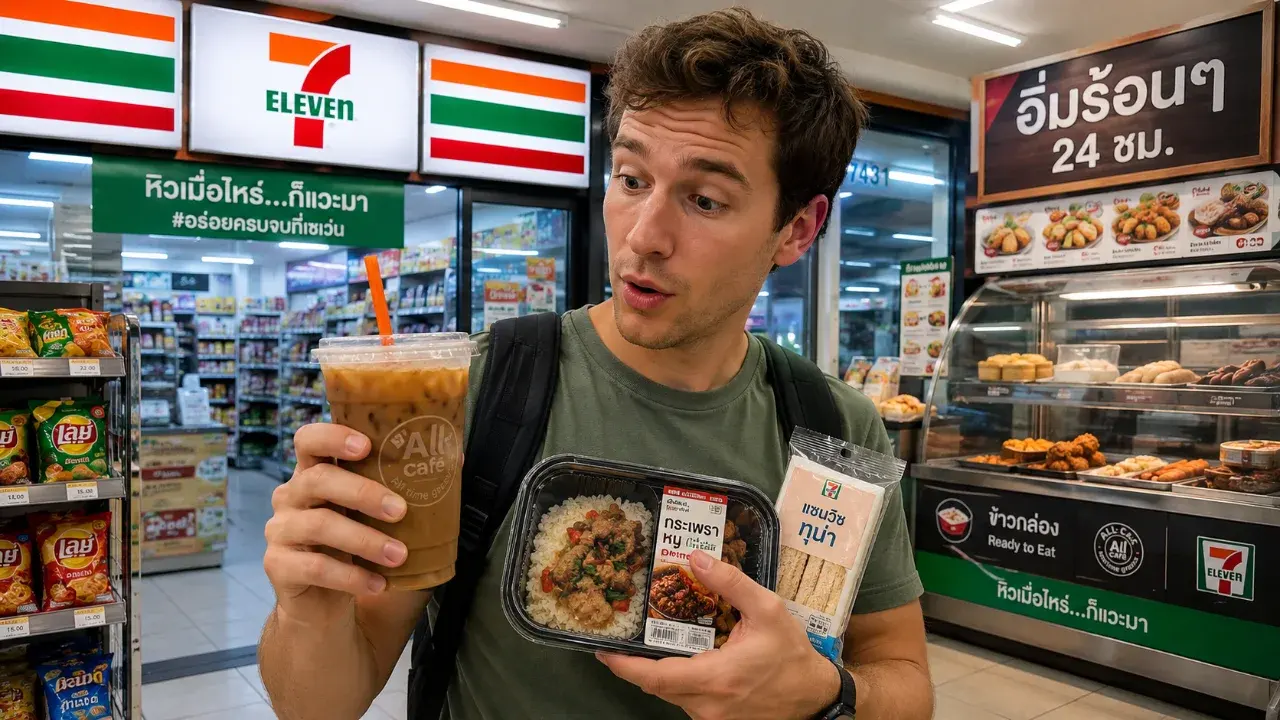
For many travelers, Thai convenience stores are more than places to buy snacks. They offer a quick look at how food, heat, service, city life, and daily routines fit together in modern Thailand.
A visitor in Thailand may walk into a convenience store just to buy water and come out with a hot meal, an iced coffee, a phone top-up, and a better understanding of how daily life works.
That is why Thai convenience stores often leave such a strong impression on foreign visitors. They look familiar at first, especially to Americans who know 7-Eleven or gas-station stores back home, but the way people use them in Thailand can feel very different.
They are not just backup stops for chips, soda, or forgotten toiletries. In many Thai neighborhoods, convenience stores work like tiny service hubs, quick food counters, late-night shelters from the heat, and everyday problem-solvers.
Thailand’s 7-Eleven stores are operated by CP ALL, which describes itself as the sole operator of the chain in the country, while the Thai 7-Eleven website lists categories such as food and bakery, drinks, member promotions, delivery-related services, and store search features.
For visitors, that mix can be quietly surprising.
You may not notice it all at once. You simply step inside, feel the blast of air conditioning, see people buying real meals instead of only snacks, watch staff heat food or prepare drinks, and realize the store is part of the rhythm of the street.
They are part of daily life, not just emergencies
In many countries, convenience stores are places people visit when they are driving, need gas, or forgot something small.
In Thailand, especially in cities and busy towns, they are woven into the day.
Office workers stop in before work for iced coffee. Students grab quick lunches. Apartment residents buy eggs, detergent, bottled water, snacks, or a late dinner. Motorbike taxi drivers cool down near the entrance. Travelers pick up supplies before a beach trip, temple visit, train ride, or early tour.
This is one reason the stores feel so useful. They fit a way of life where many people buy in smaller amounts, eat outside the home often, and move through dense neighborhoods on foot, by motorbike, taxi, train, or bus.
For an American reader, the closest comparison may be a convenience store, mini grocery, coffee counter, and quick-service food stop combined into one small space. But even that does not fully capture the Thai version, because the store is shaped by local habits.
Rice meals matter. Iced drinks matter. Small snacks matter. Fast service matters. A cool indoor stop also matters when the weather is hot and humid.
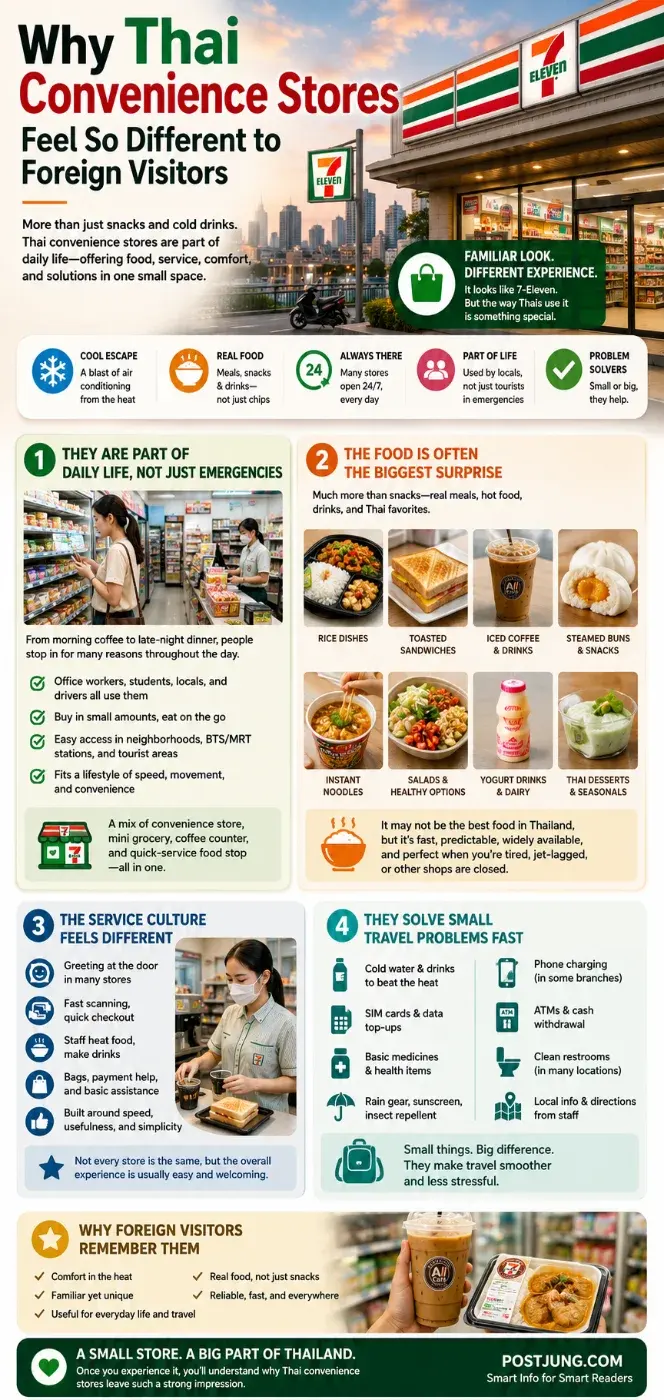
The food is often the biggest surprise
For many visitors, the food is what makes Thai convenience stores memorable.
The selection often goes far beyond candy, chips, and bottled drinks. Travelers may find toasted sandwiches, rice dishes, sausages, instant noodles, steamed buns, salads, yogurt drinks, Thai desserts, chilled coffee, and seasonal products.
Staff may heat meals, toast sandwiches, or help prepare simple drinks. The official Thai 7-Eleven site also presents food, bakery, and drink categories as major parts of the customer experience.
That matters because many customers are not only looking for a snack. They may need a complete meal in a few minutes.
This does not mean convenience store food is the best food in Thailand. Street stalls, markets, local restaurants, food courts, and family-run shops still offer a deeper and more varied food experience.
But convenience store food fills a different role. It is predictable, fast, widely available, easy to understand, and useful when other options are closed or when a traveler is tired, jet-lagged, or unsure where to eat.
After a long flight, a late hotel check-in, or a rainy night in Bangkok, Chiang Mai, Phuket, or Pattaya, that reliability can feel surprisingly comforting.
The service culture feels different too
Another detail foreign visitors often notice is the service.
The interaction is usually quick, but it can feel more organized and helpful than what some travelers expect from a convenience store.
There may be a greeting at the door. Staff scan items quickly, heat food, offer bags, help with payment, or point customers toward basic items. Even when the store is busy, the process often feels built around speed and usefulness.
Not every branch is the same. Tourist-heavy locations can be crowded. Some staff may not speak much English. Busy stores may feel rushed.
Still, the basic experience is often easy for outsiders to understand.
Bright lights. Clear prices. Cold drinks. Hot food. Quick checkout.
For a traveler dealing with heat, language differences, unfamiliar streets, or a long day of sightseeing, that simplicity has real value.
They solve small travel problems fast
Thai convenience stores are also memorable because they handle the tiny problems that can make travel stressful.
Need water before visiting a temple? Easy.
Need tissues, sunscreen, a toothbrush, an umbrella, a phone cable, or a snack for a bus ride? Also easy.
Need something simple to eat when you do not want to decode a full Thai menu? The store can be a low-pressure option.
This is especially useful because convenience stores are commonly found near hotels, condo buildings, transit stations, markets, universities, hospitals, and busy roads.
A traveler may not know where the nearest supermarket is. They may not know which local restaurant is still open. But they will often spot a convenience store quickly.
That makes the store a low-stress entry point into local life. You do not need to bargain. You do not need to speak much Thai. You can walk in, look around, and figure things out.
What Americans may notice first
American visitors may compare Thai convenience stores with gas-station stores, CVS-style stops, or 7-Eleven branches in the United States.
The Thai version can feel different for three main reasons.
First, many stores are tied to walking culture, apartment living, and public transportation rather than only car-based errands.
Second, the food often feels more meal-oriented, with rice dishes, hot items, Asian-style snacks, chilled desserts, and iced drinks that match local eating habits.
Third, the stores are socially woven into the street. People use them throughout the day, not only while driving somewhere or making an emergency stop.
That is part of the appeal: small space, high usefulness.
They do not replace Thai food culture
One common misunderstanding is that Thai convenience stores are popular only because they are everywhere.
Location matters, but it is not the full story.
They are popular because they fit how many people live. Not every apartment has a large kitchen. Not everyone shops in bulk. Many people need quick meals, cold drinks, small household items, or a short break from the heat.
Another misunderstanding is that convenience stores replace local food culture.
In reality, they sit beside it.
Thailand still has street food, wet markets, night markets, mall food courts, noodle shops, family restaurants, and local cafes. Convenience stores fill the gaps between those options.
They are there when it is raining, when someone is too tired to go to a market, when a student needs a fast meal, when a traveler arrives late, or when someone wants something predictable.
That flexibility is what makes them feel so present.
A small window into modern Thailand
Thai convenience stores reveal something simple but important about modern Thailand.
Daily life is fast, practical, food-focused, mobile, and shaped by heat, density, work schedules, and neighborhood routines.
Inside one small store, a visitor may see Thai snacks beside global brands, rice meals beside imported chocolate, iced coffee beside traditional sweets, beauty products beside phone accessories, and delivery or membership services beside everyday groceries.
It is not the postcard version of culture. It is everyday culture.
That may be why foreign visitors remember these stores. They are ordinary, but they are not empty of meaning.
They show what people buy, eat, need, and reach for during a normal day.
Sometimes the most revealing travel moments do not happen at famous landmarks. They happen under fluorescent lights, choosing a cold drink while local life moves around you.
Thai convenience stores feel different because they are not just convenient.
They are practical, social, food-focused, and deeply adapted to the way people live.
KEY TAKEAWAYS:
- Thai convenience stores often work as food stops, mini service centers, and neighborhood essentials, not just snack shops.
- Many foreign visitors are surprised by the range of ready-to-eat meals, drinks, and everyday items.
- For American travelers, the biggest difference may be how connected the stores are to walking, apartments, transit, and street life.
- Convenience stores do not replace Thai street food or markets; they fill practical gaps in daily life.
- The appeal comes from speed, predictability, air conditioning, food, and easy access.
Original source material, CP ALL, 7-Eleven Thailand
References:
https://www.cpall.co.th/en/about-us/
https://www.7eleven.co.th/

เขียนโดย Postjung Insights
 โรงเรียนที่มีนักเรียนมากที่สุดในไทย
 ดูหนัง–ซีรีส์ฟรีอาจไม่ฟรีอย่างที่คิด! เปิดโทษละเมิดลิขสิทธิ์ เตือนคนปล่อยคอนเทนต์เถื่อน เสี่ยงทั้งคุกทั้งปรับ
 รู้หรือไม่? เปิดรายได้พนักงานส่งพัสดุของแต่ละแอป วันหนึ่งได้เท่าไร
 เปิด 5 โรงเรียนหญิงล้วนเก่าแก่ของไทย ที่มีประวัติยาวนานกว่าศตวรรษ
 แมงป่อง: แมลงนักล่าสายพันธุ์โบราณของโลก ที่ยังคงอยู่มาจนถึงปัจจุบัน
 สถิติย้อนหลัง 10 ปี ออกเลขไหนบ้างมาดูกัน
 อำเภอที่มีชื่ออำเภอสั้นที่สุด 3 อำเภอเท่านั้นในประเทศไทย
 รมว.วัฒนธรรมเอาจริง! จ่อส่งหนังสือทักท้วง Miss Universe Cambodia ปมใช้ภาพหญิงกำแพงเพชร หากไม่แก้ เตรียมใช้กฎหมาย
 5 คณะที่เรียนจบมาแล้ว มีอาชีพรองรับมากกว่าที่คิด
 นักวิชาการ ม.อ.ไม่ปลื้ม! "ลิซ่า" ชวนดื่มหมดแก้ว ลั่น! เหยื่อเหล้าในไทยตายเยอะกว่าก่อการร้ายทั่วโลก
 มัดรวมจับเลขชน สัตว์นำโชค 1 ตุลาคม 2569
 แมคาเดเมีย (Macadamia): ราชินีแห่งถั่ว กับขุมทรัพย์โภชนาการจากออสเตรเลีย
 English Edition