Why pet insurance becomes more complicated as pets age

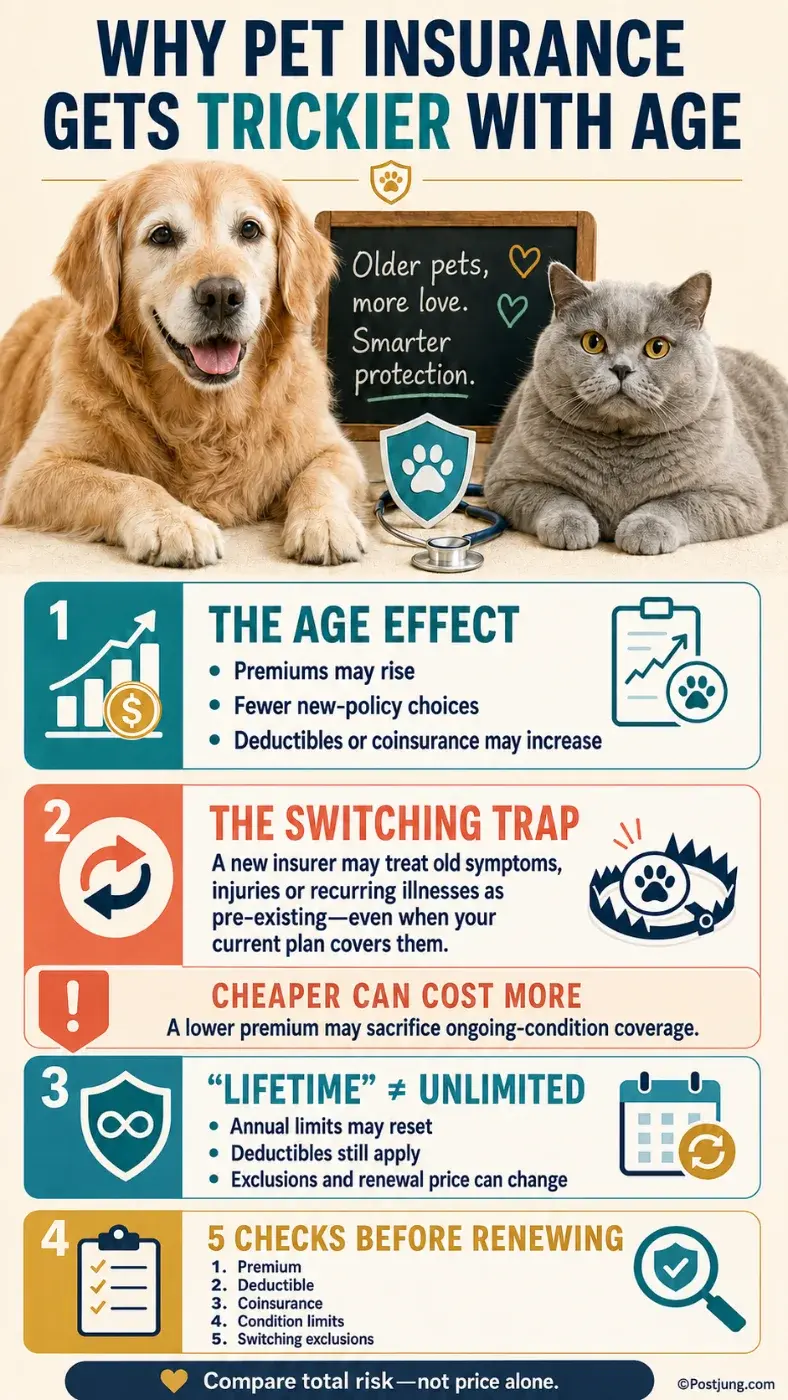
Older pets may face higher premiums, fewer new-policy options, and exclusions tied to their medical history. The most important complication, however, may be what happens when an owner tries to switch insurers.
Pet insurance does not suddenly stop working when a dog or cat becomes a senior. It does, however, become harder to evaluate because age can affect several parts of a policy at once: price, eligibility, exclusions, cost-sharing, and the value of staying with the same insurer.
The exact rules differ by country, insurer, and product. There is no universal age at which a pet becomes uninsurable, but owners of older animals generally need to examine far more than the monthly premium.
Age can affect both price and eligibility
Pet insurance premiums are calculated using multiple risk factors. These may include the animal’s species, breed, age, location, medical or claims history, and the coverage selected.
The U.S. National Association of Insurance Commissioners says some insurers stop accepting new pets after a specified age. It also identifies age as one of the variables that can affect a policy’s monthly cost. The Association of British Insurers similarly warns that premiums may rise as a pet gets older. NAIC and ABI
An age limit for joining is not necessarily the same as an age limit for remaining insured. A company may decline new applications above a certain age while continuing to renew policies for pets enrolled earlier. Owners should confirm both rules instead of assuming that “senior pets accepted” guarantees lifelong renewal on unchanged terms.
Medical history makes switching more difficult
The biggest complication is often not age itself but the medical record accumulated over time.
Most pet insurance is designed to cover future, unexpected problems—not conditions that existed before coverage began. If an animal develops arthritis, diabetes, recurring skin disease, or another long-term condition while insured, the current policy may cover eligible treatment according to its terms.
Moving to a new insurer can change that position. The new company may classify the condition as pre-existing and exclude related treatment. A cheaper premium can therefore come with a costly loss of protection.
MoneyHelper, a financial guidance service backed by the U.K. government, cautions that changing insurers may cause owners to lose coverage for long-term conditions. It also notes that replacement insurance is usually priced using the pet’s age when the new policy begins. MoneyHelper
This creates a form of policy lock-in. An owner may technically remain free to shop around, but the pet’s medical history can make an otherwise attractive replacement policy less useful.
Before switching, owners should ask the prospective insurer to explain in writing how it would treat every diagnosed condition, recurring symptom, medication, previous injury, and pending investigation in the veterinary record.
A higher premium may be only part of the increase
Owners often focus on the renewal price, but an older pet’s out-of-pocket costs can rise in other ways.
A policy may include:
- A fixed deductible or excess that the owner pays
- Coinsurance requiring the owner to pay a percentage of each eligible bill
- An annual, lifetime, or per-condition reimbursement limit
- Different reimbursement methods or benefit schedules
- Exclusions for particular treatments or conditions
Some policies may change the deductible, coinsurance, coverage, or premium as a pet ages. The NAIC’s U.S. model law calls for disclosure of limits involving deductibles, coinsurance, waiting periods, and annual or lifetime caps. It also calls for insurers to disclose whether age can reduce coverage or increase premiums. The model is a regulatory template, however—not a guarantee that identical rules apply in every U.S. state. NAIC Pet Insurance Model Act
Consider a policy that reimburses 80% of an eligible veterinary bill. Even if the annual limit remains unchanged, the owner must still fund the remaining 20%, any deductible, excluded services, and charges above the insurer’s recognized amount.
Owners should therefore compare the total amount they might personally pay, not just the annual premium.
Policy type matters more as chronic illness becomes possible
Not all pet insurance follows the same coverage structure.
Accident-only insurance generally excludes illnesses. Time-limited policies may cover an eligible condition only for a specified period. Maximum-benefit policies can stop paying for a condition once its particular limit has been reached.
Lifetime-style coverage may renew the available allowance for eligible continuing conditions each policy year, provided the owner renews without a break and complies with the contract. “Lifetime” does not mean unlimited treatment at no personal cost; annual limits, deductibles, coinsurance, exclusions, and renewal premiums can still apply.
These distinctions become particularly important for an older pet that develops a condition requiring medication, monitoring, or repeated treatment over several years.
Five questions to ask before every renewal
Before renewing or replacing a policy, ask:
- Will the premium, deductible, coinsurance, or coverage limits change because of the pet’s age?
- Are current and recurring medical conditions still covered next year?
- How are chronic conditions treated when the policy renews?
- What would a new insurer exclude after reviewing the full veterinary record?
- How much could the owner have to pay during a high-cost year?
Owners considering cancellation should first obtain written replacement terms and wait until the new coverage is confirmed. A gap in insurance or premature cancellation can leave the pet without protection, while the old policy may be impossible to restore on the same terms.
Pet insurance for an older animal is not automatically poor value. Its usefulness depends on the protection retained, the exclusions applied, the owner’s ability to pay deductibles and uncovered bills, and the financial consequences of losing coverage for an ongoing condition.
The safest comparison is not “old premium versus new premium.” It is “what protection and financial risk will remain after the change?”
This is general information, not individualized insurance or financial advice. Policy definitions and consumer protections vary by jurisdiction, so owners should verify the current contract and consult the insurer or local insurance regulator before changing coverage.
SOURCES USED:

เขียนโดย Postjung Insights
 เปิดรายชื่อ 5 โรงเรียนเป้าหมาย เด็กสอบเข้าต้องเตรียมตัวให้พร้อม
 โรงเรียนที่มีนักเรียนมากที่สุดในไทย
 รู้หรือไม่? เปิดรายได้พนักงานส่งพัสดุของแต่ละแอป วันหนึ่งได้เท่าไร
 อำเภอที่มีชื่ออำเภอสั้นที่สุด 3 อำเภอเท่านั้นในประเทศไทย
 ตาราง “เด่นเหนือเด่นใต้” งวด 1 ต.ค. 69 เปิดข้อมูลตามโพย เลขไหนอยู่ตรงไหน
 Ctrip แพลตฟอร์มการท่องเที่ยวของจีน เปิดขายตั๋วสำหรับทริปท่องเที่ยวอวกาศ ของ Virgin Galactic 6 วัน ในราคาประมาณ 24 ล้านบาท
 ซาบีดา” เรียกถกด่วน ปมภาพ “ชุดไทย” ถูกนำไปอ้างเป็นชุดกัมพูชา
 แปลปกสลาก งวด 1 ต.ค. 69 ส่องตัวเลขจากภาพปกสลากกินแบ่งรัฐบาล
 หนุ่มขับ Porsche ใจหล่อสุดๆ ติดประกาศเด็กหายไว้รอบคัน..หวังช่วยเผยแพร่ข้อมูลให้ตามหาได้เร็วขึ้น
 ส่องเลข 3 สำนักพิมพ์ งวด 1 ต.ค. 69 ตัวไหนมีข้อมูลตรงกัน
 เปิด 5 โรงเรียนหญิงล้วนเก่าแก่ของไทย ที่มีประวัติยาวนานกว่าศตวรรษ
 จากอินเดียสู่เส้นทางสายไหม! เจาะลึก “การเผยแผ่พระพุทธศาสนา” ปรากฏการณ์เปลี่ยนโลกเมื่อกว่า 2,500 ปีก่อนซาบีดา” เรียกถกด่วน ปมภาพ “ชุดไทย” ถูกนำไปอ้างเป็นชุดกัมพูชาเปิดรายชื่อ 5 โรงเรียนเป้าหมาย เด็กสอบเข้าต้องเตรียมตัวให้พร้อมหนุ่มขับ Porsche ใจหล่อสุดๆ ติดประกาศเด็กหายไว้รอบคัน..หวังช่วยเผยแพร่ข้อมูลให้ตามหาได้เร็วขึ้น
 วาบิ-ซาบิ (Wabi-Sabi) ปรัชญาญี่ปุ่นที่สอนให้เราโอบกอดความไม่สมบูรณ์แบบ
 English Edition