Why Thailand’s Rainy Season Feels More Beautiful Than Visitors Expect
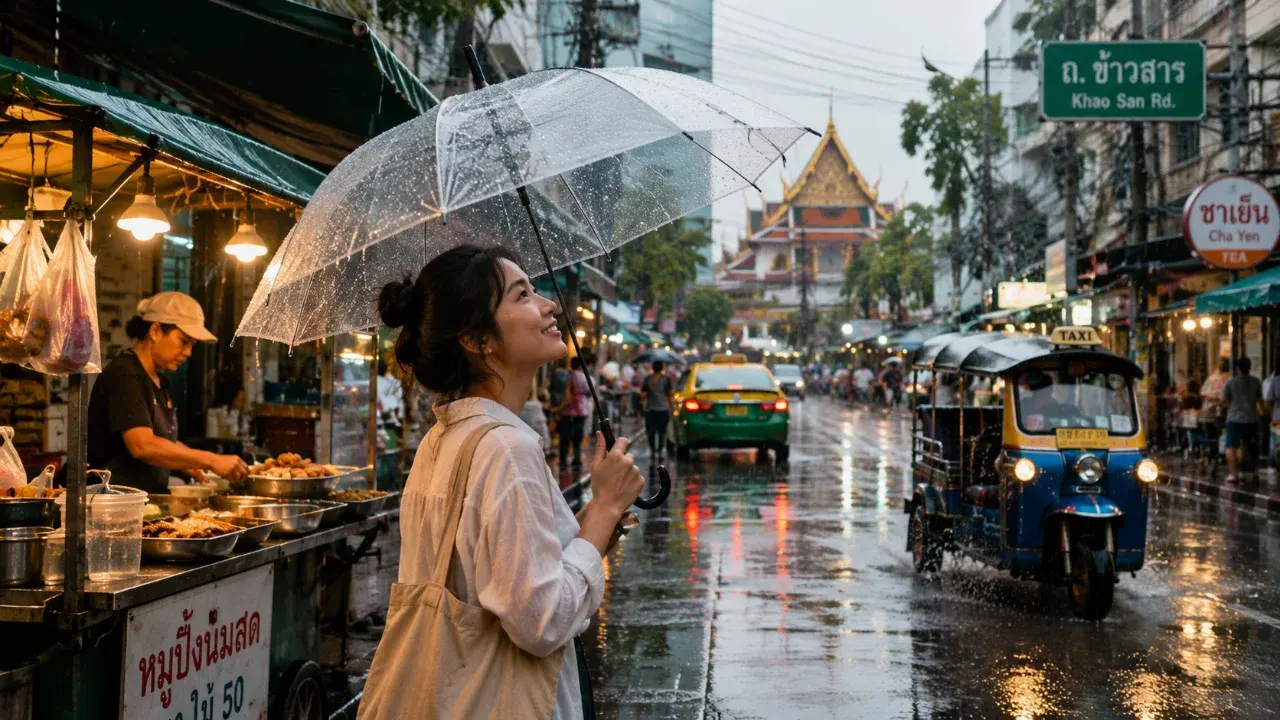
Rain changes Thailand, but it does not stop it. For many visitors, “rainy season” sounds like a ruined holiday: grey skies, flooded streets, cancelled beach days, and clothes that never quite dry. But in Thailand, the wet months can reveal a different kind of beauty — greener landscapes, softer light, slower days, and everyday scenes that feel more real than any postcard.
A storm in Bangkok can arrive after a hot afternoon and turn an ordinary street into a moving picture. Motorbike riders pull on plastic ponchos. Food vendors lower their awnings. Office workers gather under shopfronts with iced coffee in one hand and a phone in the other. The smell of grilled pork, wet pavement, and warm air mixes together in a way that feels unmistakably Thai.
Then, often, the rain passes.
The street starts moving again. Noodle carts keep serving. Markets reopen their narrow walking paths. Taxis splash through puddles. Someone shakes water from a blue umbrella and orders dinner as if nothing unusual happened.
That is the part many first-time visitors do not expect. Rainy season in Thailand is not only weather. It is a rhythm.
Rain shows how Thailand adapts
Thailand’s rainy season is usually shaped by the southwest monsoon, which brings wetter conditions across much of the country from around mid-May to mid-October. That does not mean every day is washed out from morning to night. In many places, rain arrives in bursts — a heavy afternoon shower, a dramatic evening storm, or a night of rain that leaves the morning air cooler and softer.
What visitors notice most is how quickly daily life adjusts.
A plastic stool is moved away from the edge of an awning. A takeaway bag is tied a little tighter. A vendor covers sauce bottles. A customer waits three minutes before crossing the road. A motorbike taxi driver checks the sky, shrugs, and pulls out a rain jacket.
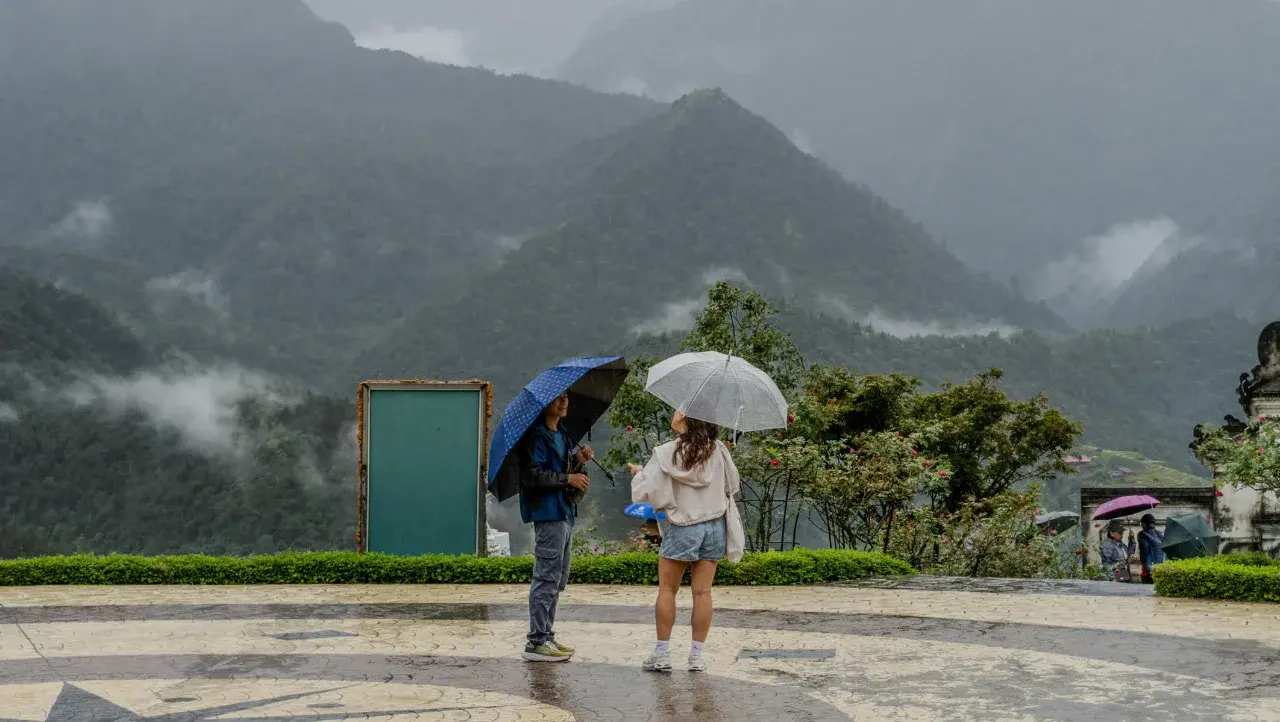
Nothing feels dramatic. Life simply bends around the rain.
In the dry season, Thailand often looks bright, sunny, and postcard-ready. In the rainy season, it can feel more intimate. You notice how people share space under small roofs. You notice how calmly daily life continues. You notice how practical and flexible Thai street culture really is.
A morning market after rain has its own beauty. Vegetables look fresher. Metal roofs drip quietly. Steam rises from rice porridge pots. Vendors wipe down tables while customers step carefully between puddles. A woman buying curry may hold an umbrella with one hand and point to her order with the other.
It is ordinary, but it stays in memory.
The “green season” is something visitors can actually see
Rain gives Thailand a different color.
Outside the cities, the change is even more obvious. Rice fields turn bright green. Hills look fuller. Waterfalls become stronger. Roadside trees look washed and vivid. Even small towns can feel newly awake after a heavy shower.
That is why some people call this period the green season. The phrase can sound like tourism language, but it describes something real. The rain gives the country depth, texture, and movement.
Northern Thailand can feel especially atmospheric when clouds sit low over the hills. In provinces such as Chiang Mai, Chiang Rai, Nan, and Mae Hong Son, rainy months can bring misty mountain views, quieter roads, and a softer mood than the busy cool season.
In central Thailand, rain can make canals, temple grounds, old markets, and riverside communities feel more alive. In Bangkok, it gives the city reflections — neon lights on wet roads, temple roofs under dark clouds, street-food stalls glowing under plastic covers.
Thailand in the rain is not always convenient. But it is often beautiful in a way that dry weather cannot copy.
The best rainy-season moments are small
Visitors often arrive expecting Thailand’s big scenes: beaches, temples, night markets, islands, rooftop bars, and sunset viewpoints.
Rainy season gives them something else — smaller scenes that feel personal.
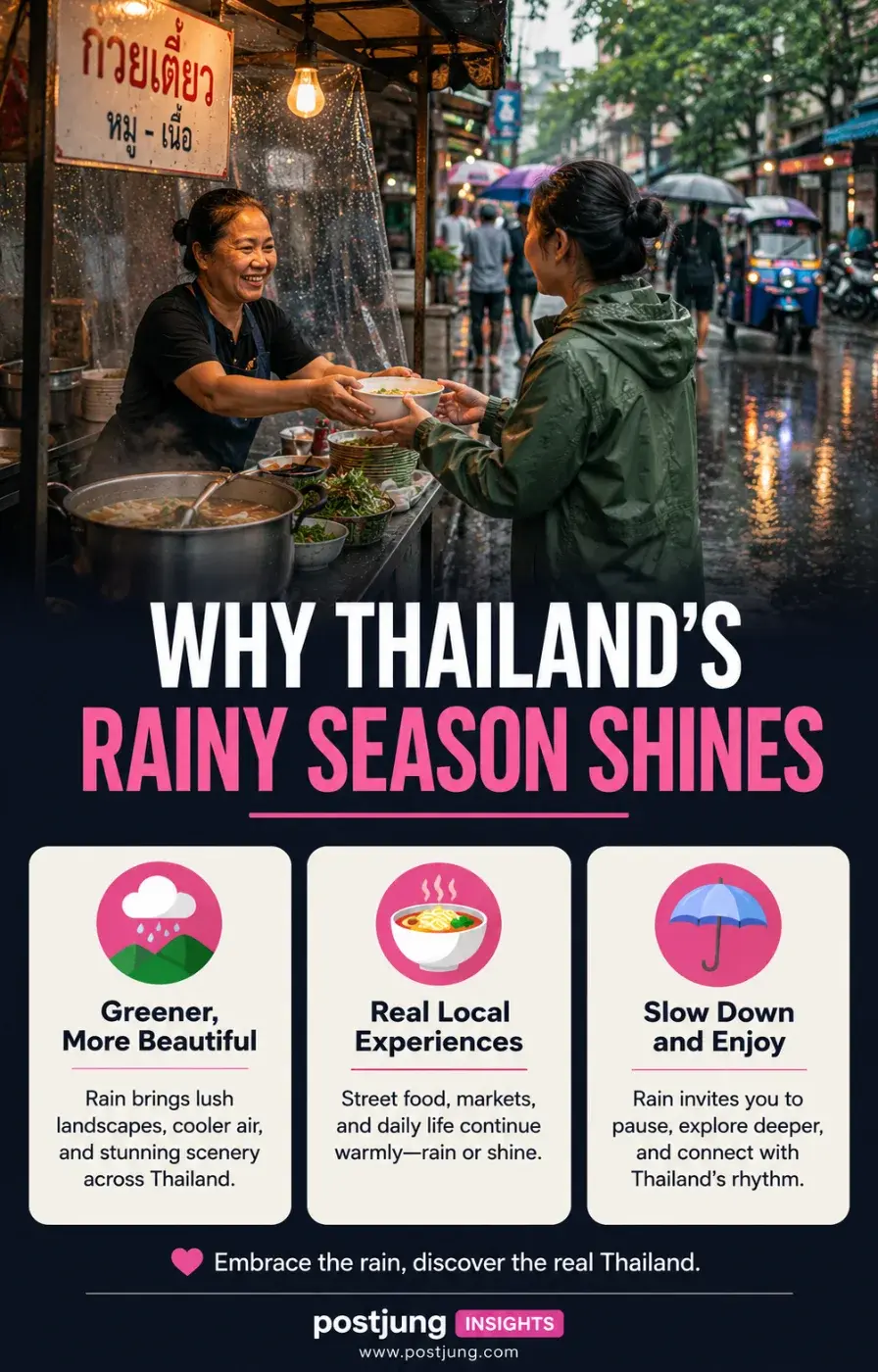
A vendor handing over hot soup in a plastic bag while rain taps on the roof.
A motorbike taxi driver waiting under a flyover, orange vest bright against the grey street.
A group of students laughing as they run through a sudden shower.
A temple courtyard becoming quiet after the rain, with wet tiles reflecting gold and red.
A roadside café where everyone pauses for twenty minutes, not because anyone planned to, but because the sky decided.
These are not the polished images usually used to sell Thailand. But they often explain the country better.
Thailand is not memorable only because it is beautiful. It is memorable because daily life keeps producing small human scenes — practical, warm, funny, patient, and alive.
Rain makes those scenes easier to notice.
Thai food feels different when the rain starts
Food is one of the easiest ways to understand Thailand, and rainy season makes that even clearer.
A bowl of hot noodles feels different when the air cools after a storm. Grilled chicken smells richer when charcoal smoke hangs under a wet market roof. Rice porridge in the morning feels more comforting. Fried bananas, soy milk, boat noodles, and spicy soups all seem made for weather that arrives suddenly and leaves the streets shining.
Rain also shows how important street food is to everyday life in Thailand. It does not disappear just because the weather changes. Vendors prepare for it. Customers expect it. A small plastic roof, a stack of stools, a fan, a ladle, a bucket, a gas stove — somehow the system keeps working.
For a visitor, this can be more memorable than a perfect restaurant meal.
You see food not as a performance, but as part of how the country moves.
And that is one of the quiet lessons of rainy-season Thailand: comfort does not always come from luxury. Sometimes it comes from sitting under a plastic awning with a hot bowl of noodles while the street shines around you.
Bangkok becomes easier to understand in the rain
Bangkok is often described as chaotic, hot, crowded, and overwhelming. Rain gives the city another personality.
A sudden storm can turn the city into a shared waiting room. People gather under BTS stations, convenience stores, office towers, and food-stall roofs. Strangers stand close but usually quietly. Someone checks a delivery app. Someone eats a skewer. Someone watches water run along the curb.
Then the rain slows, and the city restarts.
This pause-and-restart rhythm is very Bangkok. The city does not become calm exactly, but it becomes more readable. You see how people manage inconvenience without turning it into a public drama. You see the small patience built into daily life.
For visitors, this can be one of the most revealing Bangkok experiences.
Not a famous temple. Not a rooftop bar. Not a shopping mall.
Just twenty minutes under an awning, watching the city breathe.
The islands do not all follow the same weather story
One mistake visitors often make is treating “Thailand weather” as if the whole country has one forecast. It does not.
Rain in Bangkok may still leave plenty of room for temples, cafés, covered markets, malls, massage shops, museums, and street food. Rain on an island can affect boats, beaches, snorkeling, diving, and sea visibility. Rain in the mountains may create beautiful mist, but it can also make roads, waterfalls, and trails more risky.
The Andaman side — including Phuket, Krabi, Phang Nga, Koh Phi Phi, and Koh Lanta — can face rougher seas and more disrupted boat travel during monsoon periods. The Gulf side — including Koh Samui, Koh Phangan, and Koh Tao — can follow a different rainfall pattern, although conditions still change and storms can still happen.
This is why smart rainy-season travel in Thailand is not about avoiding rain completely. It is about understanding where you are.
A rainy day in Bangkok can become a food-and-market day. A rainy day in Chiang Mai can become a café, temple, and misty-mountain day. A rainy day on an island may require more caution, especially if boats, swimming, snorkeling, or diving are involved.
The same rain can create different travel realities depending on the place.
Respect the weather, then enjoy the season
Romanticizing rainy season too much would be unfair. Thailand’s rain can be serious.
Heavy downpours can cause street flooding in cities. Rural and mountain areas can face flash flood risks. Strong monsoon winds can make sea conditions dangerous, especially for small boats and swimmers. Red flags on beaches are not decoration. They are there for a reason.
Visitors should stay practical: check local weather warnings, listen to boat operators and hotel staff, avoid risky waterfall or mountain trips during heavy rain, protect phones and passports, and build extra time into travel days.
Packing does not need to be complicated. A light umbrella, quick-dry clothes, sandals or shoes that can get wet, a waterproof phone pouch, and a small dry bag can make a big difference. Heavy raincoats are often too hot unless you are riding a motorbike or traveling in exposed areas.
The most useful thing to pack may be flexibility.
Go out in the morning. Rest during a heavy afternoon shower. Eat somewhere nearby. Wait for the sky to clear. Walk again in the evening when the heat has softened.
Sometimes, the best part of the day is the thing you did while waiting for the rain to stop.
Why rainy Thailand stays in memory
Perfect weather can make a place look beautiful. Imperfect weather can make a place feel real.
Rainy season shows Thailand in motion. It reveals how markets adapt, how food culture continues, how strangers share shelter, how cities absorb inconvenience, and how nature returns color to the country.
It also gives visitors permission to slow down.
Instead of rushing from landmark to landmark, you may sit in a small café and watch rain fall over a narrow soi. You may spend longer at lunch. You may notice the sound of temple bells after a storm. You may remember the vendor who smiled while tying your takeaway bag extra tight so the rain would not get in.
These are not always the moments that appear on travel posters.
But they are often the ones people talk about when they go home.
Thailand’s rainy season is not perfect. It can be messy, humid, inconvenient, and unpredictable. But it can also be gentle, green, cinematic, and surprisingly emotional.
For visitors who arrive with patience, it offers something better than a flawless holiday photo.
It offers a closer look at how Thailand really lives.
References:
https://www.tmd.go.th/en
https://www.tmd.go.th/en/weather/weatherthailand
https://www.tourismthailand.org/Plan-Your-Trip/Weather
https://www1.ldd.go.th/ldd_en/en-US/seasons/

เขียนโดย Postjung Insights
 หญิงไทยถูกแฟนหนุ่มรัดคอดับในไต้หวัน โดยศพถูกซ่อนไว้ในตู้แช่แข็งของบริษัท
 ตาราง “เด่นเหนือเด่นใต้” งวด 1 ต.ค. 69 เปิดข้อมูลตามโพย เลขไหนอยู่ตรงไหน
 โรงเรียนที่มีนักเรียนมากที่สุดในไทย
 ใบมีดโกน ของถูกที่ผลิตยาก เบื้องหลังเหล็กพิเศษ–ความร้อน–เจียร–เคลือบผิว
 อำเภอที่มีชื่ออำเภอสั้นที่สุด 3 อำเภอเท่านั้นในประเทศไทย
 5 ไอเทมป้องกันความร้อนให้บ้านแบบโบราณ! ภูมิปัญญาเก่าที่ช่วยบ้านเย็นลงได้ 3-5 องศา
 7 คันเบ็ดตกปลาโบราณ สายเรโทรยอมทุ่มเงินซื้อ! ยิ่งเก่า ยิ่งหายาก ยิ่งมีเรื่องราว
 รู้หรือไม่? เปิดรายได้พนักงานส่งพัสดุของแต่ละแอป วันหนึ่งได้เท่าไร
 แปลปกสลาก งวด 1 ต.ค. 69 ส่องตัวเลขจากภาพปกสลากกินแบ่งรัฐบาล
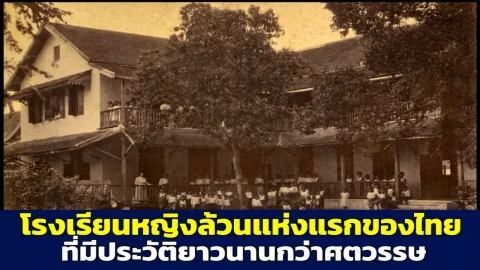 เปิด 5 โรงเรียนหญิงล้วนเก่าแก่ของไทย ที่มีประวัติยาวนานกว่าศตวรรษ
 เช็กด่วน ! ข่าวบัตรสวัสดิการแจก 10,000 บาท ก.ย. 69 จริงหรือ ? ก่อนเชื่อควรรู้อะไร
 7 บทเพลงไวรัลยุคโบราณ! เพลงงานวัดที่เปิดเมื่อไหร่ คนก็ลุกขึ้นรำวงเมื่อนั้นอำเภอที่มีชื่ออำเภอสั้นที่สุด 3 อำเภอเท่านั้นในประเทศไทย
 English Edition