Why Thai Markets Feel Most Alive Before 8 A.M.
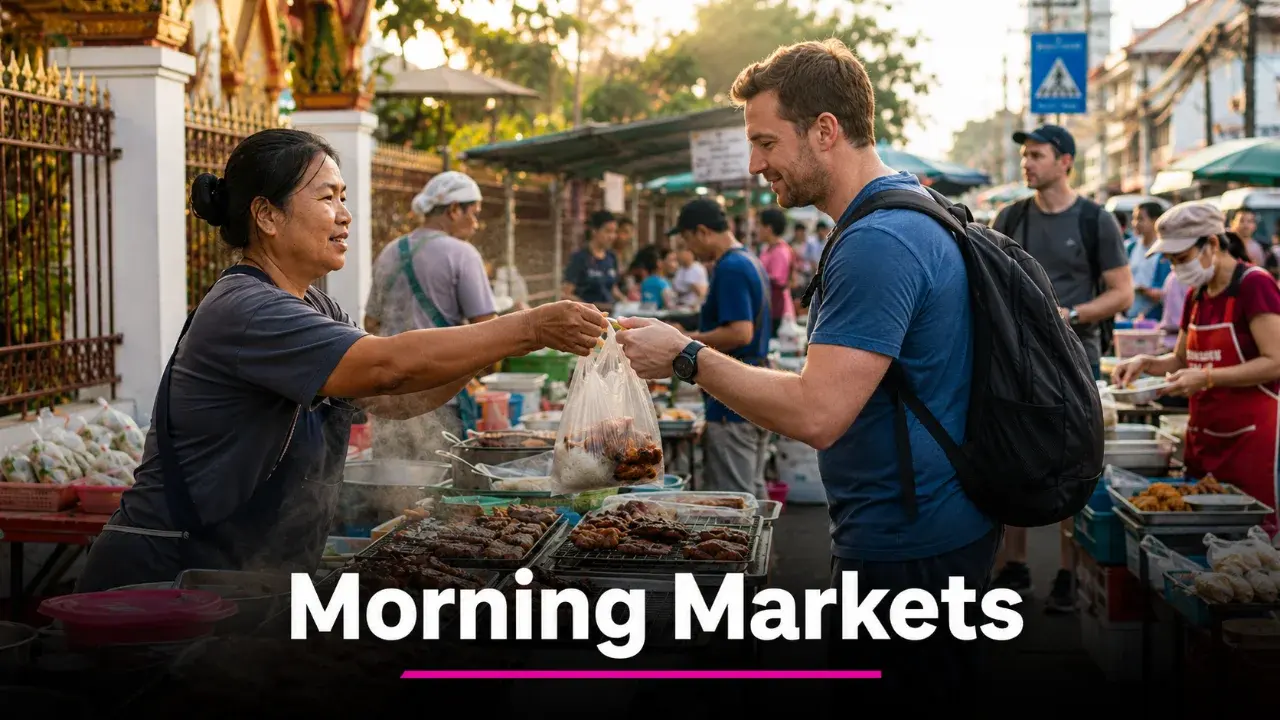
Before 8 a.m., a Thai market is not trying to impress anyone. It is simply doing its job.
Steam lifts from pots of rice porridge. Grilled pork sizzles over charcoal. Plastic bags of curry hang from hooks, ready to be carried home or to the office. Parents stop on the way to school. Office workers buy breakfast in seconds. Motorbike riders pull over, grab something warm, and disappear back into traffic.
For visitors, Thai markets are often treated as places to photograph. But early in the morning, they are something more important: a working system of food, time, family, and trust.
That is why Thai markets can feel more alive before 8 a.m. The energy is not staged for tourists. It comes from people doing what they need to do before the day fully begins.
The market works because Thai mornings move fast
In many Thai neighborhoods, the morning market is part of the daily routine, not a special outing.
People stop for breakfast, buy food for lunch, pick up ingredients for dinner, or grab something for children before school. A small bag of sticky rice with grilled pork can be breakfast. So can jok, noodle soup, soy milk, fried dough, fruit, curry over rice, or a ready-made dish packed in a clear plastic bag.
This is one reason the market feels so active. It solves several problems at once.
For many people, cooking every meal at home is not necessary, practical, or even cheaper than buying prepared food nearby. A morning market offers speed, variety, and familiarity in one place. It lets people move through the day without treating every meal as a separate project.
Before 8 a.m., the market has a clear rhythm. Customers are not browsing slowly. They know where to go, what to order, and how much time they have before work, school, traffic, or heat changes the mood of the morning.
That urgency gives the market its pulse.
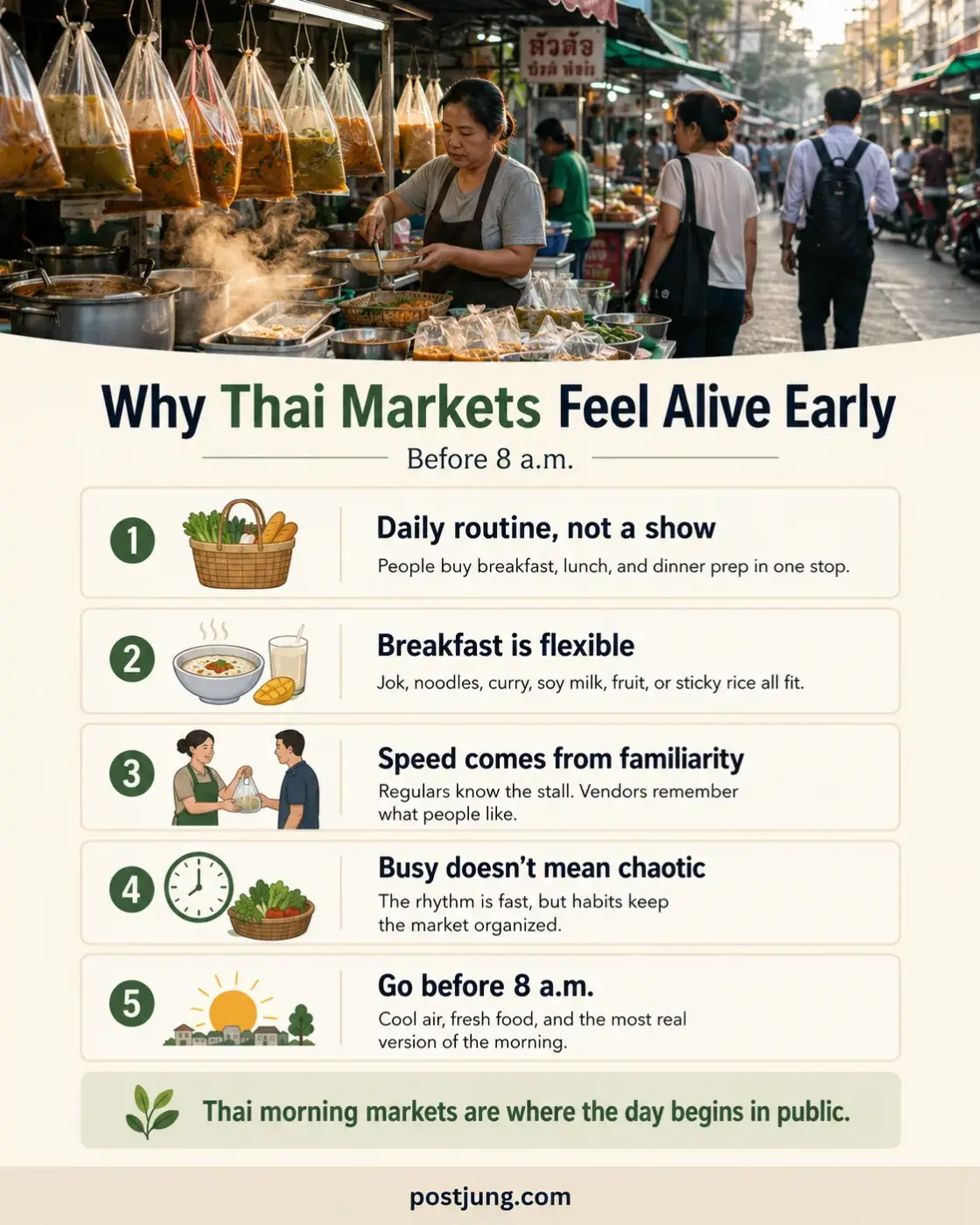
Thai breakfast is not limited to “breakfast food”
For many American readers, breakfast often has a familiar shape: coffee, toast, cereal, eggs, pancakes, or something quick from a drive-through or café.
Thai breakfast is often more flexible.
A bowl of noodles can be breakfast. Curry and rice can be breakfast. Grilled chicken with sticky rice can be breakfast. A bag of soy milk and fried dough can be breakfast. The question is not whether the food looks “morning-like” by Western standards. The question is whether it is warm, filling, affordable, and easy to eat before the day gets busy.
This flexibility is one of the quiet pleasures of Thai morning markets. They show that breakfast is not only a category of food. It is a moment in the day.
The food also tells you what kind of morning people are having. A worker may need something fast and portable. A parent may buy several small bags for the family. An older customer may sit down for something hot. A student may carry breakfast in one hand and school supplies in the other.
The market becomes a map of daily needs.
The speed comes from familiarity
One of the most interesting things about early Thai markets is how little explanation is needed.
A customer points. A vendor nods. Rice goes into a bag. Sauce is added. Coins change hands. The next person steps forward.
To an outsider, this can look rushed. But the speed often comes from familiarity, not impatience.
Regular customers know which stall makes the food they like. Vendors remember who wants extra sauce, who prefers less spicy, who buys two bags every morning, and who always asks for one more egg. These small details may seem ordinary, but they are part of what makes the market feel human.
A supermarket is efficient because of systems. A Thai morning market is efficient because of people remembering people.
That is the social layer visitors can easily miss. A market is not just a place of transactions. It is a place where tiny relationships repeat every day until they become part of the neighborhood.
What visitors often get wrong
Visitors sometimes describe Thai markets as chaotic. The word is understandable, but it misses the point.
A morning market can be crowded, loud, fast, and full of movement while still being highly organized. The organization is not always written on signs. It lives in habits: where vendors stand, where customers wait, which stall sells out early, where motorbikes slow down, and which foods are meant to be carried away.
Another common misunderstanding is that markets are mainly attractions.
Some markets are built for visitors, and many famous markets are designed to be photographed. But ordinary morning markets are closer to local infrastructure. They help people eat before work. They support small vendors. They connect cooks, suppliers, farmers, delivery riders, office workers, students, retirees, and families in a compact daily economy.
For travelers, that distinction matters. The most meaningful market experience may not be the biggest one in a guidebook. It may be a small neighborhood market near a school, a temple, a bus stop, or an office street.
That is where Thailand often feels least polished and most real.
Why the hour before 8 a.m. feels different
Timing changes the whole atmosphere.
Before 8 a.m., the air is usually cooler. The food is freshly prepared. The first batches are still hot. Vendors are alert because the busiest window is short. Customers are focused because they still have somewhere to be.
There is also a kind of honesty in how people appear at that hour. They are dressed for life, not leisure: school uniforms, office shirts, aprons, delivery jackets, sandals, helmets, house clothes.
The market becomes a snapshot of the city before it puts on its public face.
By midmorning, the mood often changes. Some stalls slow down. The breakfast crowd disappears. The light gets harsher. The sharp early rhythm softens. The same street that felt electric at 6:45 a.m. may feel ordinary by 10:30.
That is why going early matters. You are not just seeing different food. You are seeing a different version of the place.
A small lesson in everyday Thailand
Thai morning markets reveal something larger than breakfast.
They show how daily life in Thailand often combines convenience with human connection. Fast does not have to mean anonymous. Affordable does not have to mean low value. Ordinary does not have to mean uninteresting.
A small bag of sticky rice and grilled pork may look simple. But behind it is a whole network: someone prepared the marinade before sunrise, someone grilled over heat in the early morning, someone delivered ingredients, someone stopped on the way to work, and someone may eat it at a desk, outside a school, or beside a parked motorbike.
That is why Thai markets feel most alive before 8 a.m. They are not just places where people buy food. They are places where the day begins in public.
For visitors, the best way to understand them is simple. Go early. Walk slowly. Watch how people order. Notice what sells quickly. Buy something small. Step aside. Eat while the morning is still cool.
The beauty of a Thai morning market is not that it feels exotic. It is that it feels useful, familiar, and fully awake before much of the city has even started.

เขียนโดย Postjung Insights
 รู้หรือไม่? เปิดรายได้พนักงานส่งพัสดุของแต่ละแอป วันหนึ่งได้เท่าไร
 Google ยอมรับแล้ว! Gemini AI เข้าถึงระบบบริษัทจริง 3 แห่ง ระหว่างการทดสอบความปลอดภัย
 เปิด 5 โรงเรียนหญิงล้วนเก่าแก่ของไทย ที่มีประวัติยาวนานกว่าศตวรรษ
 5 คณะที่เรียนจบมาแล้ว มีอาชีพรองรับมากกว่าที่คิด
 อำเภอที่มีชื่ออำเภอสั้นที่สุด 3 อำเภอเท่านั้นในประเทศไทย
 แปลปกสลาก งวด 1 ต.ค. 69 ส่องตัวเลขจากภาพปกสลากกินแบ่งรัฐบาล
 โรงเรียนที่มีนักเรียนมากที่สุดในไทย
 เลขเด็ดปฏิทิน "หลวงปู่โต๊ะ" งวดวันที่ 1 ตุลาคม 69..ส่องเลย เลขไหนให้โชค!
 ตาราง “เด่นเหนือเด่นใต้” งวด 1 ต.ค. 69 เปิดข้อมูลตามโพย เลขไหนอยู่ตรงไหน
 เปิดรายชื่อโรงเรียนในไทยที่ “ว่ายน้ำ” อยู่ในหลักสูตร เรียนจริงตั้งแต่อนุบาลถึงมัธยม
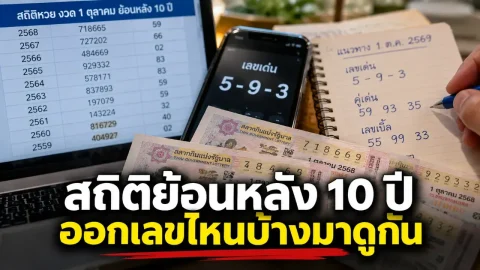 สถิติย้อนหลัง 10 ปี ออกเลขไหนบ้างมาดูกัน
 ทำไมของพลาสติกเก่าบางชิ้นถึง “เหนียว” ขึ้นมาเอง ทั้งที่ไม่ได้เปื้อนอะไร?5 คณะที่เรียนจบมาแล้ว มีอาชีพรองรับมากกว่าที่คิดเปิดรายชื่อโรงเรียนในไทยที่ “ว่ายน้ำ” อยู่ในหลักสูตร เรียนจริงตั้งแต่อนุบาลถึงมัธยมGoogle ยอมรับแล้ว! Gemini AI เข้าถึงระบบบริษัทจริง 3 แห่ง ระหว่างการทดสอบความปลอดภัยเลขเด็ดปฏิทิน "หลวงปู่โต๊ะ" งวดวันที่ 1 ตุลาคม 69..ส่องเลย เลขไหนให้โชค!ทำไมของพลาสติกเก่าบางชิ้นถึง “เหนียว” ขึ้นมาเอง ทั้งที่ไม่ได้เปื้อนอะไร?
 อุทยานเขาใหญ่เรียกตัว “ตีนผี” หลังขับจี้ช้างป่าพ่อลูก ลั่นระยะ 50 เมตรต้องจำให้ขึ้นใจ
 English Edition