Phi Ta Khon Festival: Thailand’s Ghost Parade With a Deeper Meaning
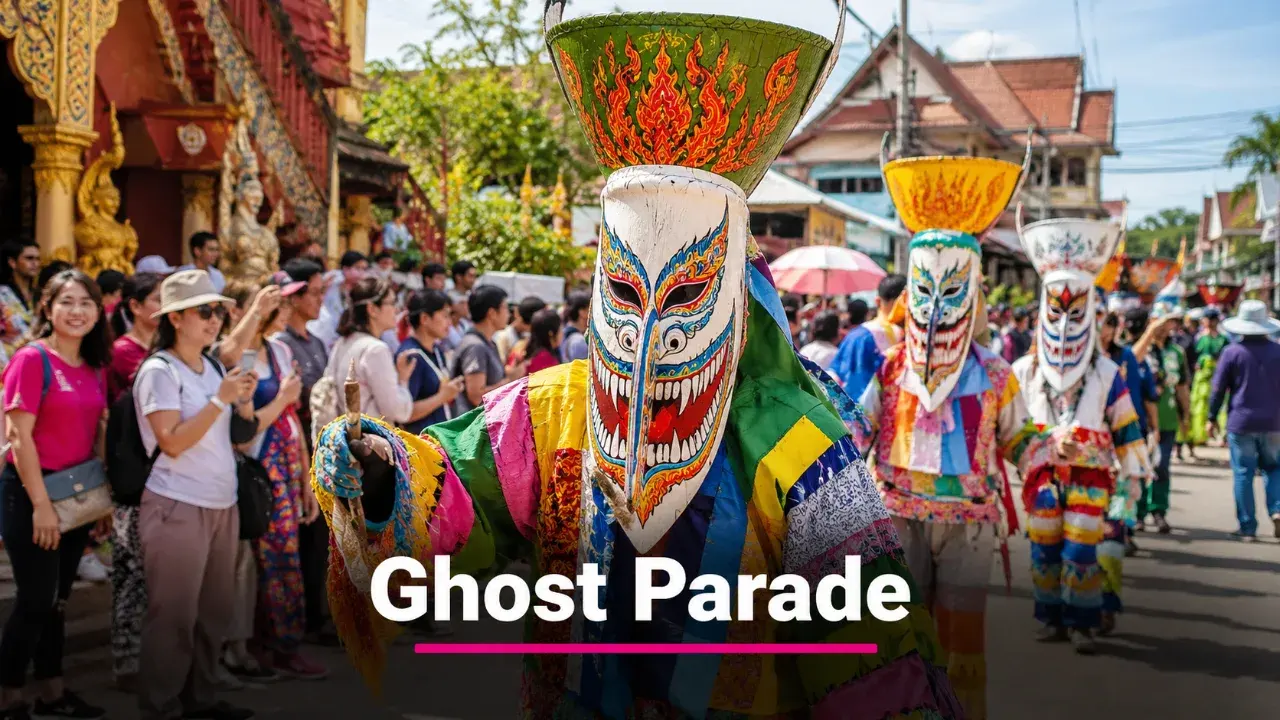
Bells ring through the streets of Dan Sai as masked dancers move past temples, homes, and crowds of visitors. Their faces are long-nosed, brightly painted, and a little unsettling. From a distance, Thailand’s Phi Ta Khon Festival looks like a ghost parade. Up close, it is something more layered: a Buddhist merit-making event, a local folk performance, and one of Loei Province’s most memorable cultural traditions.
Phi Ta Khon is often introduced in English as Thailand’s “Ghost Festival,” which is not wrong, but it can give the wrong first impression. This is not a horror event built around fear. It is noisy, playful, spiritual, handmade, and deeply rooted in Dan Sai’s local identity.
For international readers, that contrast is the most interesting part. The masks may look spooky, but the mood is closer to joy than fear.
The masks are not just costumes
The most photographed part of Phi Ta Khon is the mask. Dancers wear tall, colorful faces with exaggerated noses, painted patterns, and expressions that sit somewhere between ghost, clown, village spirit, and folk-art creature.
That strange mix is exactly why the festival stays in the memory.
Traditional Phi Ta Khon masks are associated with local materials and local craft. Tourism Authority of Thailand explains that the festival performance became part of Bun Luang, or the Great Merit-Making Festival, in Dan Sai. The same source notes that the exact origin of the name “Phi Ta Khon” is unclear, with several local variations used over time.
That uncertainty makes the tradition feel even more local. It is not a clean museum label. It is a living practice shaped by community memory, belief, and performance.
The masks are also not simply decorative. They help transform ordinary villagers into figures that feel halfway between this world and another one. For visitors, this creates the festival’s strongest visual effect: a ghost story walking through daylight.
A Buddhist festival with folk energy
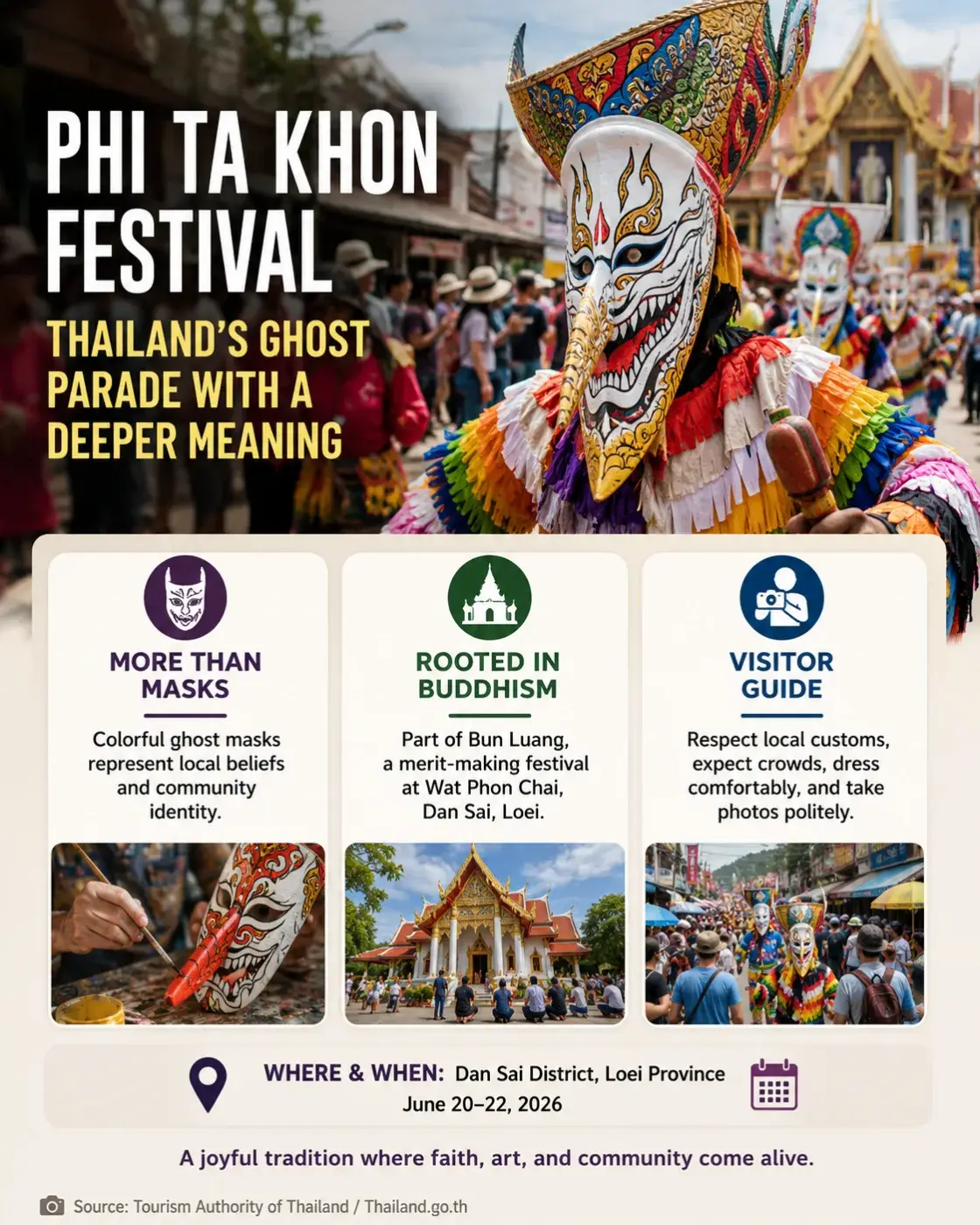
Phi Ta Khon is part of the wider Bun Luang and Phi Ta Khon Festival in Dan Sai District, Loei Province. For 2026, Thailand’s official government portal lists the event for June 20–22 at Dan Sai District Office and Wat Phon Chai, with ghost mask performances, processions, merit-making rituals, and local cultural activities.
That setting matters. Wat Phon Chai is not just a backdrop for photos. The festival is tied to religious and community life, so visitors should understand it as more than a parade route.
The event blends Buddhist merit-making with local folk belief. The “ghosts” are not presented as evil characters or Halloween-style monsters. They are part of a ritual atmosphere where music, masks, dance, and processions help express joy, identity, protection, and shared belief.
This is why Phi Ta Khon can look wild while still feeling meaningful. It allows a community to turn spiritual imagination into public movement. The street becomes the stage. The village becomes the story.
Why visitors often misunderstand it
Foreign visitors may be tempted to compare Phi Ta Khon with Halloween because of the masks and the word “ghost.” That comparison is easy, but it misses the point.
Halloween is widely associated with costumes, parties, candy, horror imagery, and seasonal entertainment. Phi Ta Khon comes from a different cultural world. It is connected to Loei’s local traditions, Buddhist timing, village participation, and the Bun Luang merit-making cycle.
So the better way to read the festival is not “Thailand’s Halloween.” It is a local merit-making festival with ghost masks.
That small shift changes everything. The masks are not there only to scare. The dancing is not only for spectacle. The parade is not only a tourism show. It is a public expression of how one Thai community carries belief, humor, memory, and artistry through the body.
That is also why the festival feels visually different from better-known Thai events such as Songkran or Loi Krathong. Songkran is watery and nationwide. Loi Krathong is candlelit and graceful. Phi Ta Khon is earthy, noisy, handmade, and strange in a way that feels very specific to Dan Sai.
What to know before going to Dan Sai
Dan Sai is in Loei, in northeastern Thailand. It is not the kind of place most international visitors pass through casually on a first Bangkok-beach itinerary. That distance is part of its charm, but it also means planning matters.
Because the main festival period is short and visually famous, visitors should expect crowds around key processions and temple areas. Comfortable clothing, sun protection, water, and a flexible schedule can make the experience much easier. Since festival dates can be tied to local and lunar timing, travelers should check official tourism sources before making fixed plans.
Respect also matters. Phi Ta Khon is highly photogenic, but it is not only a photo set. Visitors should avoid blocking processions, interrupting rituals, or treating masks as props. A good rule is simple: enjoy the color, but remember that the festival belongs first to the local community.
For anyone who wants to see Thailand beyond beaches, malls, and night markets, Phi Ta Khon offers something rare. It shows a side of Thai culture that is playful without being shallow, spiritual without being distant, and strange without being artificial.
The ghost masks may be what pull people in. But the deeper reward is realizing that Phi Ta Khon is not really about fear. It is about a community giving form to memory, belief, laughter, and local pride — all moving together through the streets of Loei.
References: https://www.tourismthailand.org/Articles/meaning-of-phi-ta-khon-festival-en, https://thailand.go.th/event-detail/bun-luang-and-phi-ta-khon-festival-2026

เขียนโดย Postjung Insights
 รู้หรือไม่? เปิดรายได้พนักงานส่งพัสดุของแต่ละแอป วันหนึ่งได้เท่าไร
 หัวลูกศรหินย้อนเวลา 80,000 ปี ในเอเชียกลาง… หลักฐานใหม่ชี้ โฮโม เซเปียนส์ อาจเคยบุกยุโรปเร็วขึ้นนับหมื่นปี!
 อำเภอที่มีชื่ออำเภอสั้นที่สุด 3 อำเภอเท่านั้นในประเทศไทย
 เปิด 5 โรงเรียนหญิงล้วนเก่าแก่ของไทย ที่มีประวัติยาวนานกว่าศตวรรษ
 โรงเรียนที่มีนักเรียนมากที่สุดในไทย
 ถ้าไม่กลัวเหนื่อย 7 อาชีพที่ตลาดยังต้องการ และค่าทักษะไปถึง 800 บาท/วัน
 ฝูงลิงญี่ปุ่นนับสิบรุมล้อมและโจมตีชายคนหนึ่งในคานากาวะ
 ตึกยาวสวนกุหลาบฯ อายุเกิน 100 ปี ทำไมยังใช้เป็นห้องเรียนมาถึงวันนี้
 อินฟลูเอนเซอร์สาวผู้สร้างคอนเทนต์สำหรับผู้ใหญ่และมีรายได้ต่อปีกว่า 33 ล้านบาท ตัดสินใจเปลี่ยนอาชีพมาเป็นแพทย์แทน
 ตาราง “เด่นเหนือเด่นใต้” งวด 1 ต.ค. 69 เปิดข้อมูลตามโพย เลขไหนอยู่ตรงไหน
 ส่องเลข 3 สำนักพิมพ์ งวด 1 ต.ค. 69 ตัวไหนมีข้อมูลตรงกัน
 นูออร์กัม: หมู่บ้านเหนือสุดขอบสหภาพยุโรป กับวัฏจักรแห่งแสงที่สุดขั้วเปิด 5 โรงเรียนหญิงล้วนเก่าแก่ของไทย ที่มีประวัติยาวนานกว่าศตวรรษหัวลูกศรหินย้อนเวลา 80,000 ปี ในเอเชียกลาง… หลักฐานใหม่ชี้ โฮโม เซเปียนส์ อาจเคยบุกยุโรปเร็วขึ้นนับหมื่นปี!ถ้าไม่กลัวเหนื่อย 7 อาชีพที่ตลาดยังต้องการ และค่าทักษะไปถึง 800 บาท/วัน
 ทำไมแผนที่ส่วนใหญ่เอาทิศเหนือไว้ด้านบน ทั้งที่โลกไม่มี “ด้านบน” จริง ๆ?
 English Edition