Thai Flower Garlands: What Phuang Malai Really Mean in Daily Life
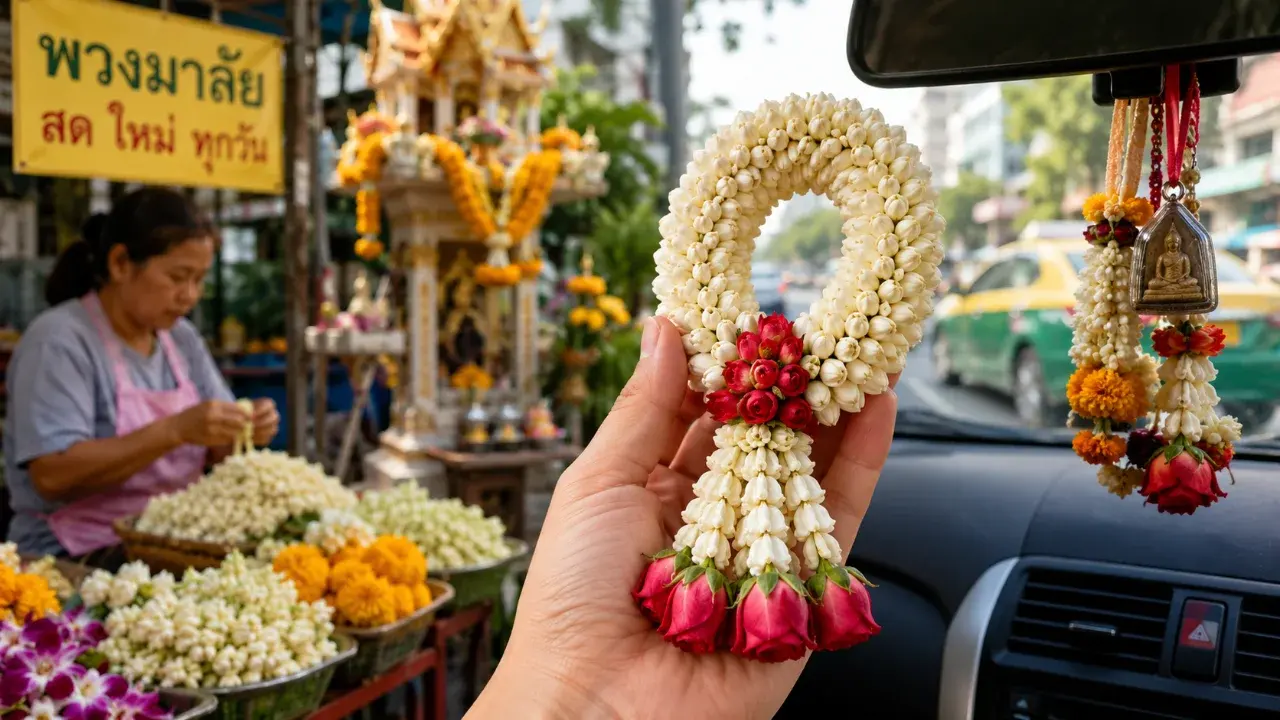
A Thai flower garland may look like a small, fragrant decoration, but in Thailand it often carries a message: respect, blessing, gratitude, protection, or welcome. Visitors see these garlands hanging from car mirrors, placed at spirit houses, offered at temples, sold near traffic lights, and worn during ceremonies. What is easy to miss is that phuang malai is not just floral beauty. It is one of Thailand’s most visible everyday symbols of care.
Walk through Bangkok’s Pak Khlong Talat flower market before dawn and you can see the life behind it. Jasmine buds, marigolds, roses, orchids, and other fresh flowers are sorted, threaded, tied, and arranged by hand. Some garlands are simple loops. Others have delicate hanging tassels, carefully layered colors, and a scent that stays with you long after you pass the stall.
For many Thais, these garlands are part of daily rhythm, not museum culture.
The flower language visitors often miss
The Thai word phuang malai generally refers to a flower garland. The word malai means garland, while phuang suggests something strung, grouped, or looped together. That shape matters. A garland is not a loose bouquet. It is something made with order, patience, and intention.
The most familiar version for visitors is the white jasmine garland. Jasmine is deeply associated with purity, tenderness, and respect in Thai culture. It is also linked to Mother’s Day in Thailand, when jasmine is often used as a symbol of a mother’s love.
Marigolds are also common, especially in offerings. Their golden-yellow color is associated with brightness, merit, and auspiciousness. Roses and orchids may appear in more decorative or ceremonial designs. The exact meaning can shift by context, but the central idea remains the same: flowers become a respectful gesture.
That is why a garland can feel both ordinary and sacred.
Why they appear in cars, temples, and businesses
One reason visitors notice phuang malai everywhere is that it moves across different parts of Thai life.
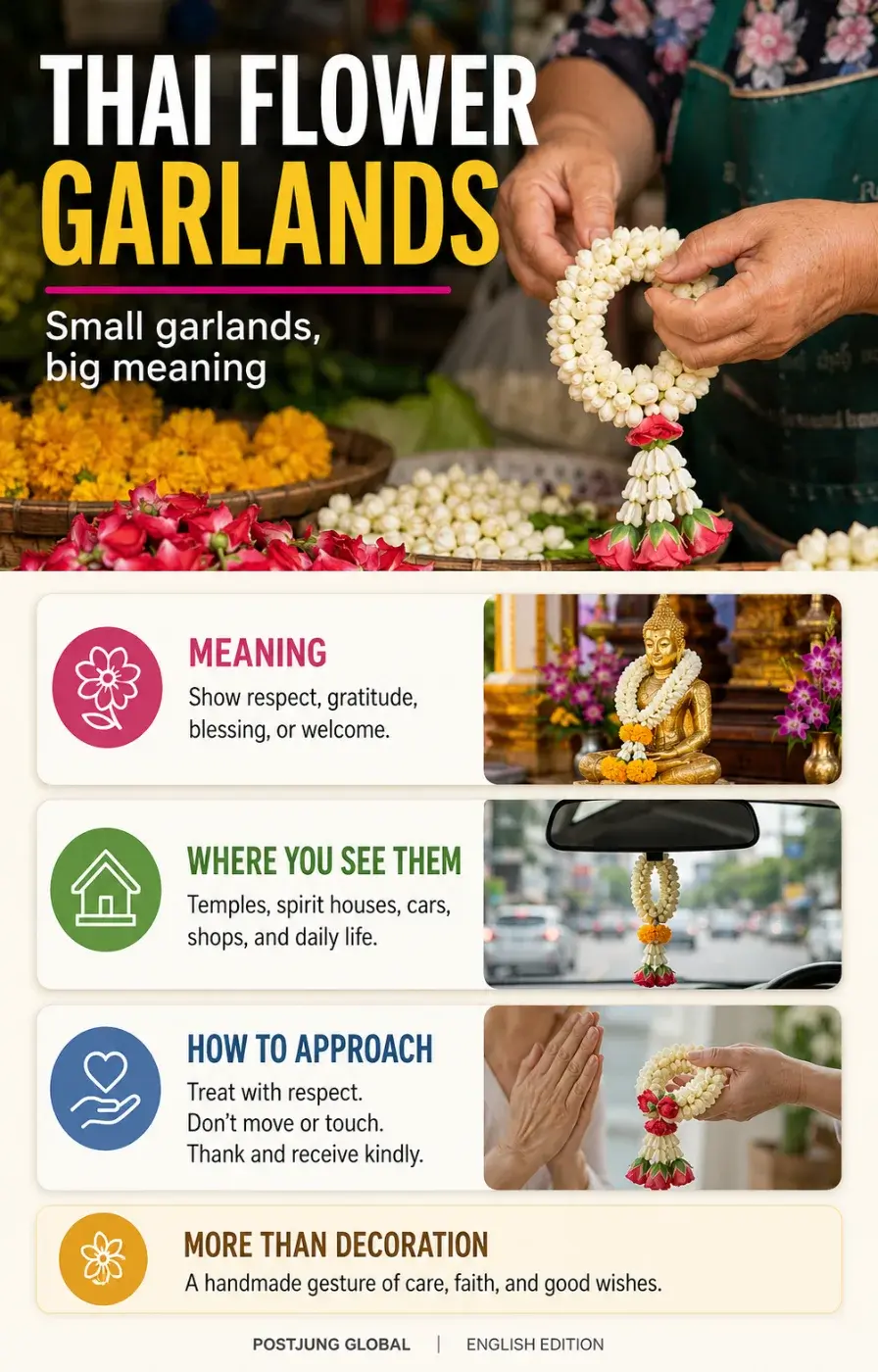
At temples, garlands are often offered to Buddha images or sacred figures as a sign of devotion and respect. At spirit houses, they may be placed as offerings to local guardian spirits. In shops and restaurants, garlands may be seen near small shrines, where owners make offerings for protection, prosperity, or good fortune.
In cars and taxis, garlands are often hung near the front mirror or placed near a small religious image. For some drivers, this is a way to ask for safety on the road. For others, it is simply part of a familiar habit passed down through family and daily life.
This is why a visitor may see the same kind of garland in very different settings: a luxury hotel lobby, a tuk-tuk, a wedding, a street stall, a market, or a small neighborhood shrine. The object stays similar, but the message changes with the place.
A handmade detail in a fast-moving country
Thailand is modern, digital, and fast. Yet phuang malai remains stubbornly handmade.
That is part of its emotional power. A fresh garland is temporary. It wilts. It must be replaced. It is not meant to last forever, and that makes the gesture feel alive. Someone bought it today. Someone chose the flowers. Someone placed it there with a thought.
At flower markets, skilled makers can thread tiny buds quickly, but the work is still delicate. The spacing, color balance, and shape all matter. A clean, tight garland signals care. A more elaborate one may be used for ceremonies or important occasions.
For visitors, this is one of the quietest ways to understand Thai culture: beauty is often tied to respect. It is not only about appearance. It is about the feeling carried by the object.
How visitors should read the scene
A good rule is simple: if a garland is placed at a shrine, temple, statue, vehicle altar, or sacred-looking space, treat it with respect. Do not move it for a better photo. Do not touch it casually. Do not joke about it as a decoration.
If someone gives you a garland, receive it politely. In some travel, hotel, or ceremony settings, a garland may be used as a welcome gesture. You do not need to know every religious or cultural detail to respond well. A smile, a small nod, or a gentle “thank you” is enough.
If you buy one, look for freshness. Jasmine should smell soft and clean. The flowers should not look heavily browned or crushed. A garland from a busy market or stall is usually meant to be used soon, not kept for days.
And if you see vendors selling garlands at intersections, remember that this is also part of urban livelihood. The garland may be cultural, but the person selling it is also working in heat, traffic, and uncertainty.
More than something pretty
Phuang malai is easy to photograph, but it is better understood slowly.
It tells visitors that Thai culture often expresses feeling through small visible acts: a wai, a food offering, a carefully arranged plate, a flower placed before a shrine. The garland may be small enough to hang from a mirror, but it carries a much larger idea.
In Thailand, flowers are not only for romance or decoration. They can be a way to say thank you, ask for protection, honor someone, welcome a guest, or mark a moment as meaningful.
That is why the Thai flower garlands visitors see everywhere deserve a second look. They are not background scenery. They are daily culture in plain sight.
References: https://jeddah.thaiembassy.org/en/content/floral-flavors-a-celebration, https://www.tourismthailand.org/Attraction/pak-khlong-talat-night-market, https://www.hope-rehab-center-thailand.com/blog/hope-stories/phuang-malai-thai-flower-garland/

เขียนโดย Postjung Insights
 รู้หรือไม่? เปิดรายได้พนักงานส่งพัสดุของแต่ละแอป วันหนึ่งได้เท่าไร
 7 บทเพลงไวรัลยุคโบราณ! เพลงงานวัดที่เปิดเมื่อไหร่ คนก็ลุกขึ้นรำวงเมื่อนั้น
 โรงเรียนที่มีนักเรียนมากที่สุดในไทย
 ตาราง “เด่นเหนือเด่นใต้” งวด 1 ต.ค. 69 เปิดข้อมูลตามโพย เลขไหนอยู่ตรงไหน
 อำเภอที่มีชื่ออำเภอสั้นที่สุด 3 อำเภอเท่านั้นในประเทศไทย
 เช็กด่วน ! ข่าวบัตรสวัสดิการแจก 10,000 บาท ก.ย. 69 จริงหรือ ? ก่อนเชื่อควรรู้อะไร
 โรงเรียนชายล้วนแห่งแรกของไทยคือที่ไหน? ย้อนดูจุดเริ่มต้นโรงเรียนสวนกุหลาบวิทยาลัย
 5 ไอเทมป้องกันความร้อนให้บ้านแบบโบราณ! ภูมิปัญญาเก่าที่ช่วยบ้านเย็นลงได้ 3-5 องศา
 เปิด 5 โรงเรียนหญิงล้วนเก่าแก่ของไทย ที่มีประวัติยาวนานกว่าศตวรรษ
 7 คันเบ็ดตกปลาโบราณ สายเรโทรยอมทุ่มเงินซื้อ! ยิ่งเก่า ยิ่งหายาก ยิ่งมีเรื่องราว
 รู้หรือไม่? ความทรงจำวัยเด็กอาจไม่ได้เหมือนที่เราเคยจำ! สมองสามารถ “เติมเรื่อง” ให้เราได้
 ส่องเลข 3 สำนักพิมพ์ งวด 1 ต.ค. 69 ตัวไหนมีข้อมูลตรงกันอำเภอที่มีชื่ออำเภอสั้นที่สุด 3 อำเภอเท่านั้นในประเทศไทย
 English Edition