Why Thailand’s Fruit Season Feels Like a Festival You Can Eat
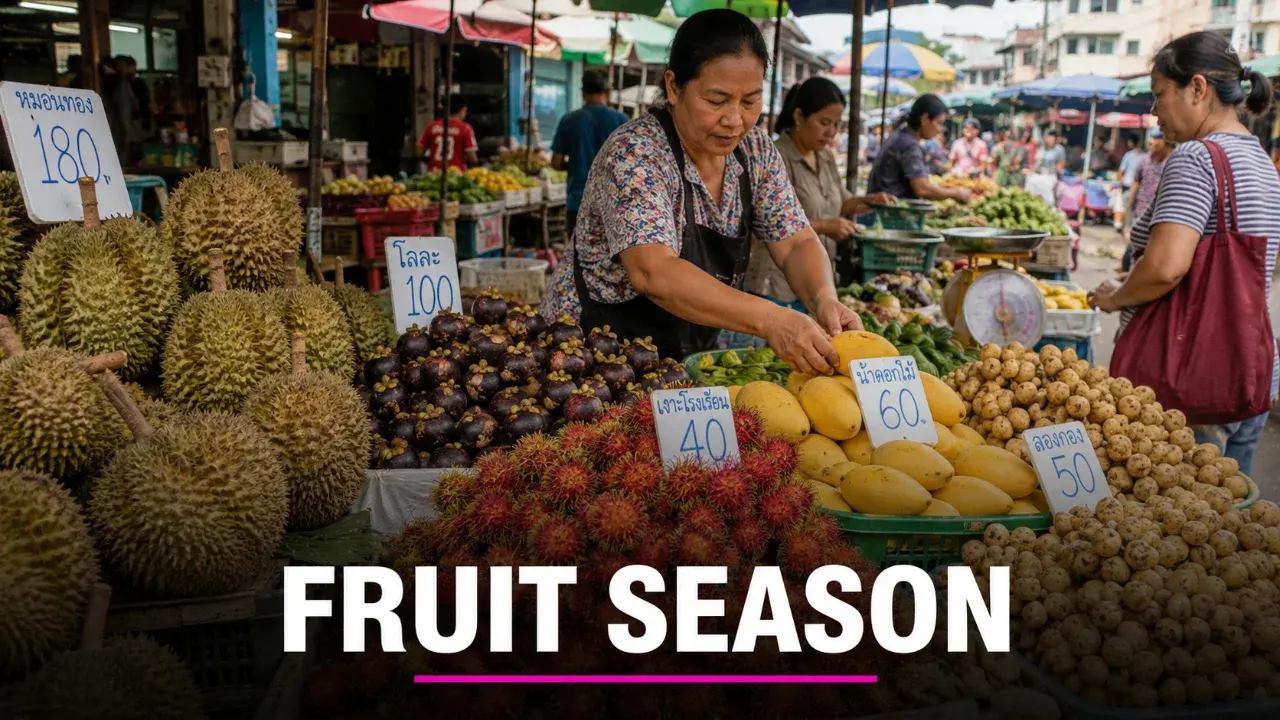
Thailand’s fruit season does not arrive quietly. It spills onto sidewalks, market tables, pickup trucks, train-station stalls, supermarket displays, and roadside orchards until daily life starts to feel brighter, sweeter, and more local. For visitors, it may look like a lucky time to eat mango, durian, mangosteen, rambutan, longkong, or lychee. For many Thais, it is more than that: a seasonal rhythm people wait for.
Unlike a formal holiday, Thai fruit season has no single opening ceremony. It is felt through smell, color, price, abundance, and conversation. A durian seller calling out from a truck. A family buying mangosteen by the kilo. A traveler discovering that the same fruit tastes different in Chanthaburi, Chiang Mai, Bangkok, or a small roadside market.
That is why fruit season in Thailand can feel like a festival of its own.
A country where fruit is part of daily life
Thailand’s climate and agricultural landscape make tropical fruit part of the country’s everyday identity. The Royal Thai Consulate-General in Shanghai describes Thailand as a fertile agrarian country known as a producer of tropical fruit, while the FFTC Agricultural Policy Platform notes that Thailand is known for fruits such as durian, mangosteen, rambutan, guava, mango, banana, coconut, and lychee.
But the emotional power of Thai fruit season is not only about variety. It is about timing.
Some fruits are available almost all year, but others become especially exciting when they arrive in their best months. Mango is closely associated with the hot season, especially March to May. In eastern Thailand, harvest season from around April to July brings large quantities of fruit into the market, including durian, mangosteen, rambutan, longkong, and santol.
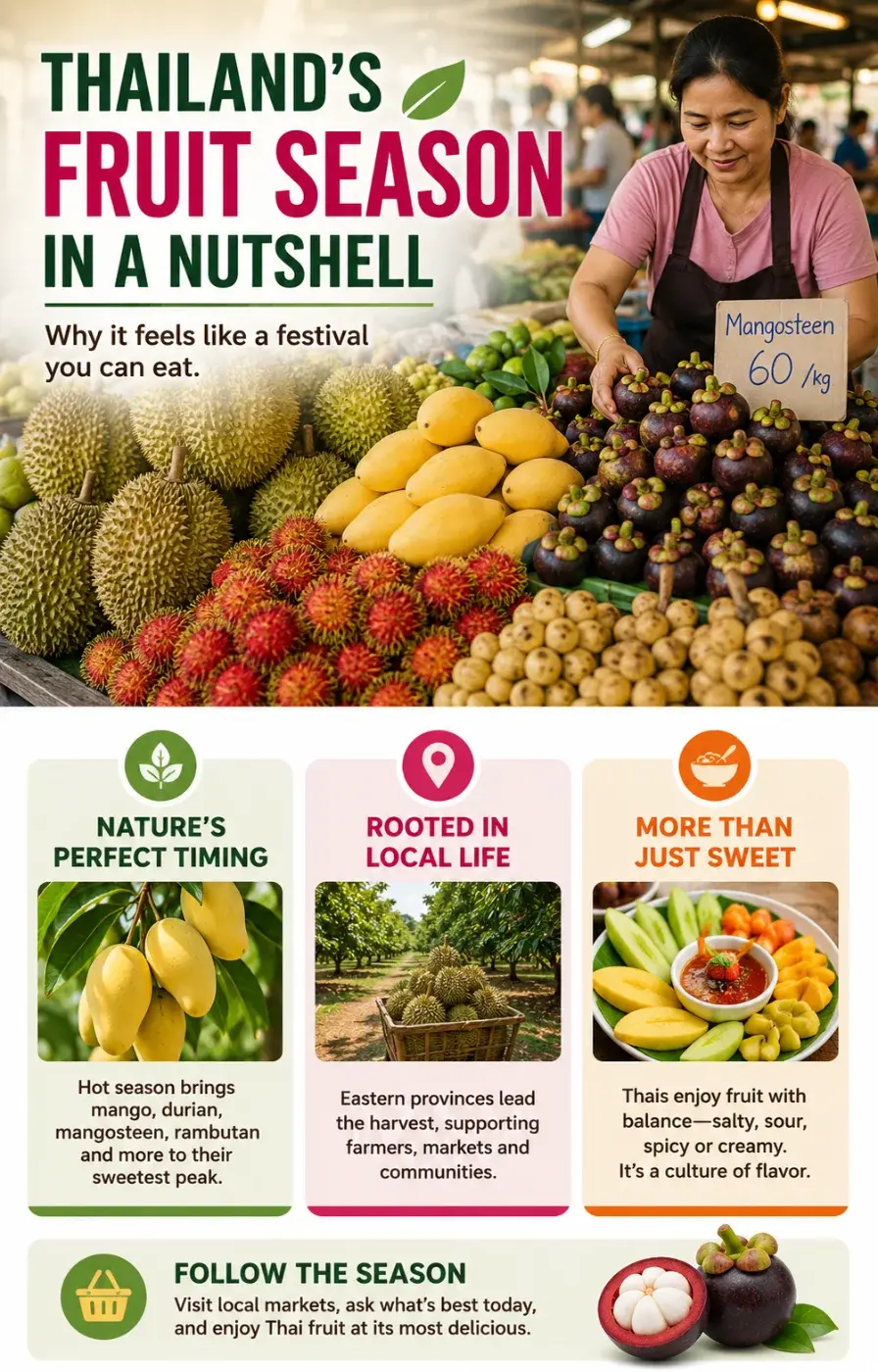
When supply rises, fruit becomes more visible. Prices may become more competitive. Market displays grow larger. People start comparing sweetness, texture, origin, and ripeness as casually as they talk about weather.
In Thailand, fruit is not just bought. Fruit is discussed, judged, shared, and gifted.
The eastern fruit belt gives the season its festival feeling
For anyone trying to understand Thailand’s fruit culture, eastern Thailand is one of the best places to start. Chanthaburi is often called the “City of Fruits,” and the surrounding eastern provinces — including Trat, Rayong, Sa Kaeo, and Prachin Buri — are strongly associated with orchards and seasonal fruit experiences.
This matters because Thai fruit season is not only a consumer moment. It is also a regional economy.
When harvests enter the market, the season affects farmers, cooperatives, sellers, exporters, tourists, and families planning weekend trips. In 2026, Thailand’s Cooperative Promotion Department prepared measures for eastern fruit including durian, rambutan, mangosteen, longkong, and santol, with the harvest expected to enter the market gradually from mid-April onward.
That detail helps explain why the season feels so alive. It is not just fruit appearing on a table. It is a whole supply chain becoming visible to ordinary people.
A traveler may see a basket of mangosteen. A Thai shopper may see the start of a regional harvest. A farmer may see weeks of careful timing. A roadside vendor may see the busiest part of the year.
That layered meaning gives Thai fruit season its festival-like energy.
Thai fruit is eaten with personality
Another reason the season feels special is the way fruit is eaten in Thailand. The experience is rarely limited to peeling and eating.
Green mango may come with nam pla wan, a sweet, salty, lightly spicy dipping sauce. Guava may be paired with chili salt or sour plum powder. Mango may meet coconut sticky rice. Durian can be eaten fresh or paired with sticky rice. Tangy fruits can be turned into loy kaew, a chilled syrup dessert that started as a way to preserve produce.
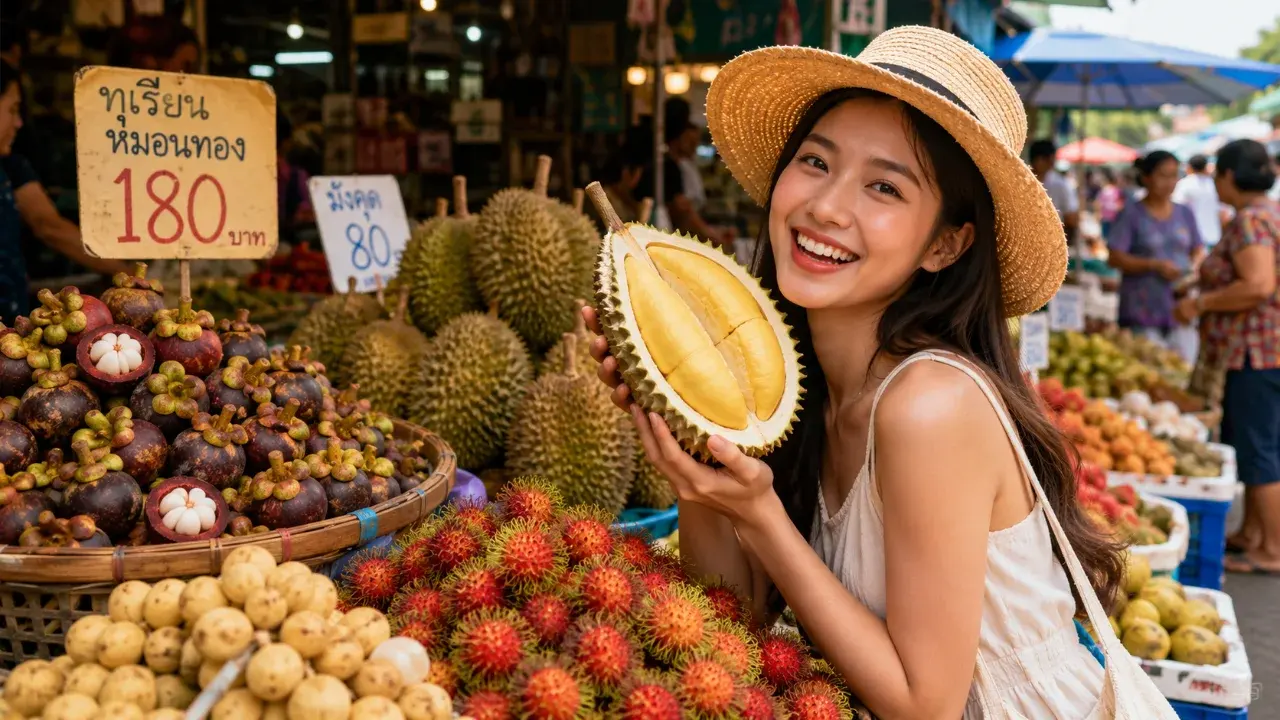
This is where Thai fruit becomes more than sweetness. It becomes balance.
A single bite may be sour, salty, spicy, fragrant, creamy, or icy cold. The fruit cart is not just selling fruit; it is selling a Thai way of balancing flavor.
For international visitors, this can be surprising. In many countries, fruit is treated mainly as a healthy snack or dessert. In Thailand, fruit can be dessert, street food, a road-trip purchase, a market ritual, a savory ingredient, or a social gift.
That flexibility makes the season feel richer.
Why visitors should slow down and follow the season
The best way to enjoy Thai fruit season is not to chase only the most famous fruit. Durian gets the attention, and mango sticky rice is internationally loved, but the deeper pleasure is learning what is good right now.
A market seller may point you toward mangosteen with glossy purple skin. A hotel breakfast may suddenly include sweeter rambutan. A local friend may tell you that longkong is better from one province than another. An orchard may offer fruit buffets when harvest is at its peak.
This is where travel becomes more memorable. Instead of treating fruit as a checklist, follow what locals are buying.
Look for piles that are moving quickly. Ask what is sweet today. Notice whether sellers separate fruits by grade, size, or origin. If you are buying durian, ask whether it is soft, creamy, or firmer, because people have strong preferences.
The small lesson is simple: Thai fruit season rewards curiosity.
A festival without a ticket
Thailand has many official festivals, from Songkran to Loy Krathong. Fruit season is different because it is not tied to one temple, one parade, or one date. It lives in markets, farms, family tables, roadside stops, delivery boxes, and neighborhood conversations.
That may be why it feels so personal. You do not need a ticket. You do not need a schedule. You only need to notice what has suddenly become abundant.
For visitors, Thai fruit season is a delicious reminder that culture is not always found in monuments or museums. Sometimes it is in a plastic bag of rambutan, a chilled bowl of fruit in syrup, a mango cut beside the road, or a durian chosen with great seriousness by someone who knows exactly how ripe it should be.
The real joy is not just eating fruit in Thailand. It is realizing that every season has its own flavor — and when the fruit arrives, the whole country seems to taste a little more alive.
References:
https://thaishanghai.thaiembassy.org/th/content/enjoy-the-best-thai-fruit-the-thai-way-a-local-gui?cate=5f0d67e59cc17760ab1a99c8
https://ap.fftc.org.tw/article/1239
https://en.thairath.co.th/news/governmentpolicy/2920945

เขียนโดย Postjung Insights
 รู้หรือไม่? เปิดรายได้พนักงานส่งพัสดุของแต่ละแอป วันหนึ่งได้เท่าไร
 โรงเรียนที่มีนักเรียนมากที่สุดในไทย
 ตาราง “เด่นเหนือเด่นใต้” งวด 1 ต.ค. 69 เปิดข้อมูลตามโพย เลขไหนอยู่ตรงไหน
 5 ไอเทมป้องกันความร้อนให้บ้านแบบโบราณ! ภูมิปัญญาเก่าที่ช่วยบ้านเย็นลงได้ 3-5 องศา
 อำเภอที่มีชื่ออำเภอสั้นที่สุด 3 อำเภอเท่านั้นในประเทศไทย
 เปิด 5 โรงเรียนหญิงล้วนเก่าแก่ของไทย ที่มีประวัติยาวนานกว่าศตวรรษ
 โรงเรียนชายล้วนแห่งแรกของไทยคือที่ไหน? ย้อนดูจุดเริ่มต้นโรงเรียนสวนกุหลาบวิทยาลัย
 แปลปกสลาก งวด 1 ต.ค. 69 ส่องตัวเลขจากภาพปกสลากกินแบ่งรัฐบาล
 7 บทเพลงไวรัลยุคโบราณ! เพลงงานวัดที่เปิดเมื่อไหร่ คนก็ลุกขึ้นรำวงเมื่อนั้น
 รู้หรือไม่? ความทรงจำวัยเด็กอาจไม่ได้เหมือนที่เราเคยจำ! สมองสามารถ “เติมเรื่อง” ให้เราได้
 ทำไมหนังสือบางเล่มถึงมีหน้าว่างทั้งหน้า? มันอาจไม่ได้พิมพ์พลาด
 7 คันเบ็ดตกปลาโบราณ สายเรโทรยอมทุ่มเงินซื้อ! ยิ่งเก่า ยิ่งหายาก ยิ่งมีเรื่องราวอำเภอที่มีชื่ออำเภอสั้นที่สุด 3 อำเภอเท่านั้นในประเทศไทย
 English Edition