Thai Harmony: 6 Everyday Habits Visitors Often Misread
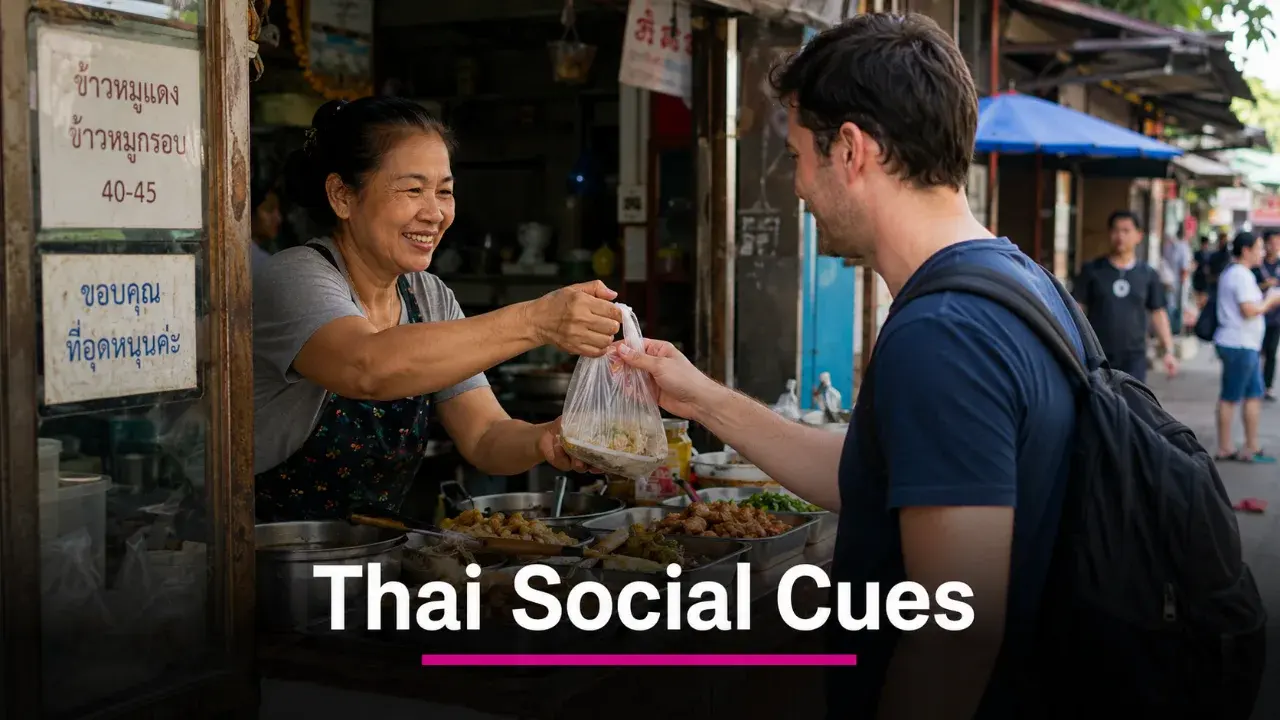
A smile in Thailand can welcome you, thank you, forgive a small mistake, or gently cool down an awkward moment. That is why everyday Thai habits can feel warm and confusing at the same time. Many visitors notice the smile, the wai, the shoes outside a doorway, or the phrase mai pen rai — but miss the social meaning underneath.
Thailand is often easy to enjoy before it is easy to understand.
Daily life here is shaped by tone, timing, body language, respect, and a strong preference for keeping the mood around people comfortable. Visitors do not need to copy every habit perfectly. But understanding a few small signals can make markets, restaurants, temples, hotels, and casual conversations feel much less mysterious.
A Thai smile may be doing more than showing happiness
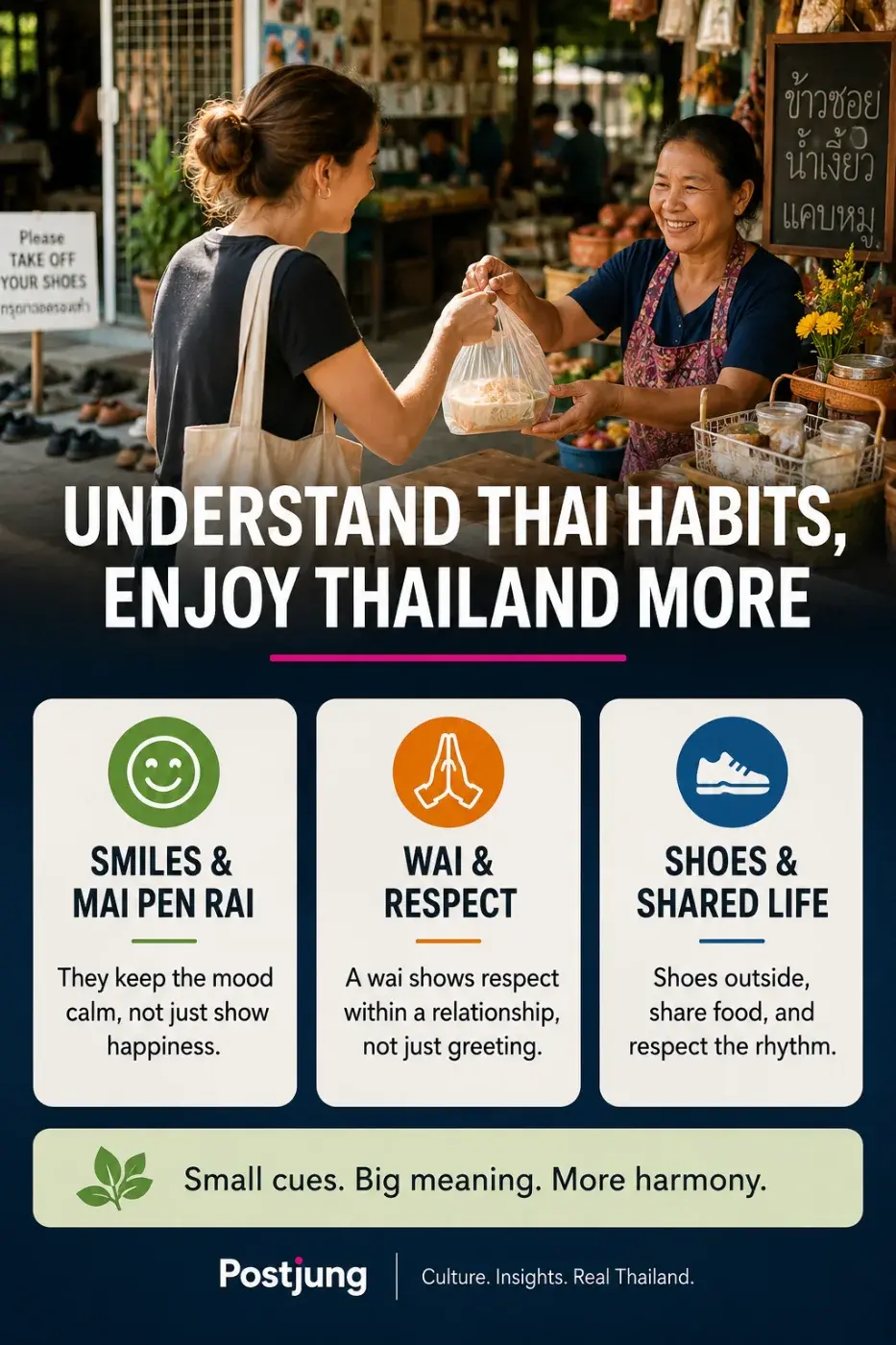
Thailand is famous for smiles, and that reputation is not imaginary. Smiling is a real part of daily interaction. But a Thai smile is not always a simple expression of joy.
It can mean thank you. It can mean sorry. It can soften a mistake. It can also mean, let’s not turn this into conflict.
The Royal Thai Embassy in Cairo notes that Thai people may smile not only to express happiness, but also to thank others for small services, return a wai, or excuse small inconveniences.
That matters because foreigners sometimes read a smile too literally. If a shopkeeper smiles while saying something is unavailable, or a taxi driver smiles after a misunderstanding, it may not mean the problem is funny. It may mean both sides are being given a graceful way to move on.
In Thailand, a smile often works like social cushioning. It keeps a small bump from becoming a public scene.
Mai pen rai is not the same as not caring
Few Thai phrases are more misunderstood than mai pen rai. It is often translated as “never mind,” “it’s okay,” or “no problem.” Those translations are useful, but incomplete.
In real life, mai pen rai can mean:
Don’t worry about it.
There is no need to argue.
We cannot fix this now, so let’s move forward calmly.
To some visitors, that can sound careless. But often, the phrase is less about laziness and more about emotional management. It lowers the temperature of a situation.
That does not mean serious problems should be ignored. If money, safety, bookings, health, or legal issues are involved, visitors should still clarify politely. The point is that many Thai conversations begin by protecting the relationship before solving the problem.
A calm voice usually gets further than public frustration.
The wai is about respect, not decoration
The wai — palms pressed together with a slight bow — is one of Thailand’s most recognizable gestures. Many visitors see it as the Thai version of a handshake.
It is more layered than that.
A wai can be a greeting, a thank you, an apology, a farewell, or a sign of respect. The Thailand Foundation describes the wai at its core as a gesture of respect, even though foreigners often associate it mainly with greeting.
The details can depend on age, status, setting, and relationship. Visitors do not need to master every rule. In most everyday travel situations, a warm smile, a small nod, and returning a wai when appropriate are enough.
What helps most is remembering this: the wai has emotional weight. A rushed, one-handed wai while holding coffee and looking away can feel awkward because the gesture is not just decorative. It says something about the relationship between people.
Shoes outside the door are a quiet instruction
In Thailand, shoes lined up outside a doorway often tell you more clearly than a sign.
If you see shoes at the entrance of a home, temple building, massage shop, clinic, small guesthouse, or certain local businesses, it is usually best to remove yours too. At one level, this is practical. Thailand is hot, dusty, and rainy; shoes bring dirt inside.
But the habit also marks a boundary.
Outside is public. Inside may be private, clean, respectful, or sacred. In homes and temples especially, removing shoes shows that you understand you are entering a different kind of space.
For visitors, the rule is easy: look down before walking in. The doorway usually tells you what to do.
Quiet disagreement does not always mean yes
In some cultures, direct disagreement is treated as honesty. In Thailand, direct public disagreement can feel unnecessarily harsh, especially if it embarrasses someone in front of others.
So a Thai person may avoid saying “no” too sharply. They might pause, smile, say “maybe,” change the subject, or answer in a softer way. A visitor may hear agreement when the real message is hesitation.
This is connected to saving face. Public embarrassment can damage a relationship more than the original problem.
That does not mean Thai people never disagree. It means disagreement is often handled with more attention to mood, timing, and social comfort.
A useful visitor habit is to listen beyond the words. If someone says “up to you” without enthusiasm, gives a vague answer, or avoids eye contact, the meaning may be closer to “I’m not fully comfortable with that.”
Shared food is part of social balance
Thai meals often look relaxed, but they have their own rhythm. Dishes are commonly shared, and people may order several plates for the table rather than one fixed meal per person.
Britannica describes Thai meals as often balancing spicy, mild, sweet, and sour dishes, which helps explain why shared plates work so naturally: one table can carry many flavors at once.
For visitors used to individual plates, this can feel surprising. But in Thailand, shared food is not only about eating. It is about inclusion.
Taking modest portions first, noticing whether others have eaten, and not finishing the best piece without checking the group are small acts of awareness. They show that you understand the meal is shared socially, not just physically.
The easiest approach is simple: slow down, look around, and follow the table’s rhythm.
The real lesson is harmony
Many Thai habits are not strict rules. They are small tools for keeping daily life smooth, gentle, and socially comfortable.
A smile may not mean simple happiness. Mai pen rai may not mean indifference. A quiet answer may not mean agreement. A wai may carry more respect than it first appears to. Shoes outside a door may be the clearest instruction in the room.
The heart of it is harmony.
Visitors do not need to become Thai to appreciate Thailand. But once they understand these small habits, everyday moments begin to look different. A hotel greeting, a shared meal, a market exchange, or a quiet apology can suddenly feel less confusing — and much more human.
References:
https://cairo.thaiembassy.org/en/publicservice/78738-tips-and-facts-about-thailand
https://www.britannica.com/place/Thailand/Daily-life-and-social-customs
https://thailandfoundation.or.th/wai-the-thai-greeting/
https://www.thaiembassy.com/thailand/thailand-customs

เขียนโดย Postjung Insights
 5 ไอเทมป้องกันความร้อนให้บ้านแบบโบราณ! ภูมิปัญญาเก่าที่ช่วยบ้านเย็นลงได้ 3-5 องศา
 รู้หรือไม่? เปิดรายได้พนักงานส่งพัสดุของแต่ละแอป วันหนึ่งได้เท่าไร
 7 บทเพลงไวรัลยุคโบราณ! เพลงงานวัดที่เปิดเมื่อไหร่ คนก็ลุกขึ้นรำวงเมื่อนั้น
 อำเภอที่มีชื่ออำเภอสั้นที่สุด 3 อำเภอเท่านั้นในประเทศไทย
 โรงเรียนที่มีนักเรียนมากที่สุดในไทย
 เช็กด่วน ! ข่าวบัตรสวัสดิการแจก 10,000 บาท ก.ย. 69 จริงหรือ ? ก่อนเชื่อควรรู้อะไร
 ทำไมหนังสือบางเล่มถึงมีหน้าว่างทั้งหน้า? มันอาจไม่ได้พิมพ์พลาด
 เปิด 5 โรงเรียนหญิงล้วนเก่าแก่ของไทย ที่มีประวัติยาวนานกว่าศตวรรษ
 7 คันเบ็ดตกปลาโบราณ สายเรโทรยอมทุ่มเงินซื้อ! ยิ่งเก่า ยิ่งหายาก ยิ่งมีเรื่องราว
 โรงเรียนชายล้วนแห่งแรกของไทยคือที่ไหน? ย้อนดูจุดเริ่มต้นโรงเรียนสวนกุหลาบวิทยาลัย
 ตาราง “เด่นเหนือเด่นใต้” งวด 1 ต.ค. 69 เปิดข้อมูลตามโพย เลขไหนอยู่ตรงไหน
 แปลปกสลาก งวด 1 ต.ค. 69 ส่องตัวเลขจากภาพปกสลากกินแบ่งรัฐบาลอำเภอที่มีชื่ออำเภอสั้นที่สุด 3 อำเภอเท่านั้นในประเทศไทย
 English Edition